
Funding Support for Financial Deputies
Protect client funds. Evidence statutory duties. Secure the right provision.
Financial deputies are often asked to fund care, therapy, education, rehabilitation, transport, support workers, placements and specialist provision from a protected party’s private funds.
But not every cost should automatically fall to the client’s estate.
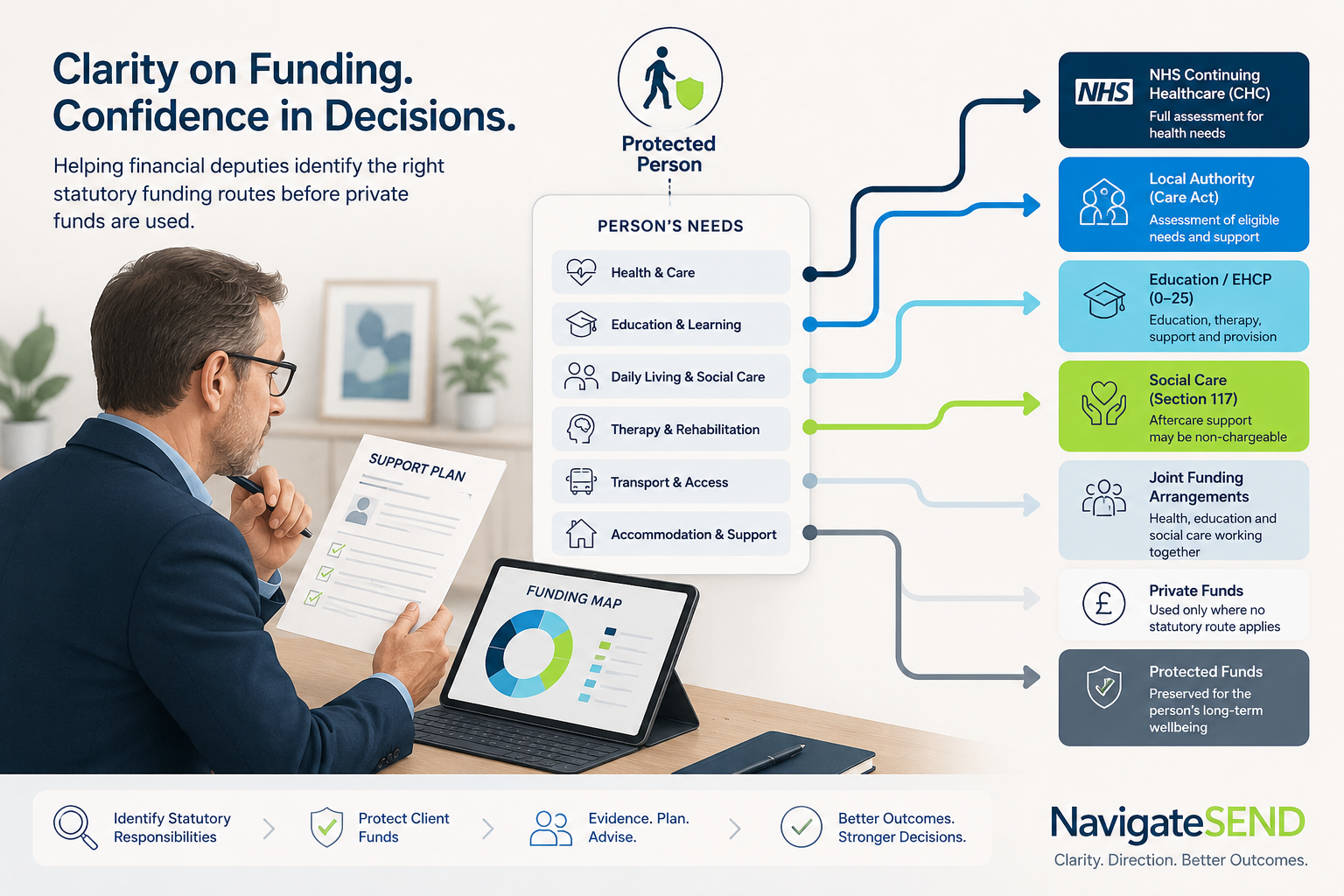
Some needs may be the responsibility of the NHS, the local authority, the education system, adult social care, children’s services, or a jointly funded statutory pathway. Our specialist statutory funding service helps deputies understand what should be paid privately, what may be publicly funded, and what evidence is needed to make clear, defensible decisions.
We support financial deputies, Court of Protection teams, family deputies and professional advisers where complex disability, brain injury, SEND, rehabilitation, education, health and social care funding overlap.
Registered with:
Specialist statutory funding advice for complex deputyship cases
Deputies have a duty to act in the protected party’s best interests and manage funds carefully. The Office of the Public Guardian’s guidance for property and affairs deputies explains that financial decisions must be made in the person’s best interests and in keeping with the size of their estate.
That can be difficult when a person has complex, lifelong or changing needs.
A deputy may be asked to fund:
- a private care package;
- therapy or rehabilitation;
- specialist education;
- a personal assistant or support worker;
- school or college transport;
- home adaptations;
- psychological input;
- tutoring or EOTAS provision;
- nursing or healthcare support;
- transition planning into adulthood;
- accommodation-related support;
- family support or respite.
The key question is not simply whether the support is needed.
The key question is:
Who is legally or practically responsible for meeting this need, and what evidence is required to secure that funding?
That is where we help.
Why this matters for financial deputies
There are more than 61,000 deputyship orders supervised by the Office of the Public Guardian in England and Wales. As at 31 March 2025, the OPG reported that it was supervising 61,038 deputyship orders.
Many of those clients have complex disability, acquired brain injury, learning disability, autism, mental health needs, SEND, physical disability, degenerative conditions or significant care and rehabilitation requirements.
At the same time, the statutory systems that should provide support are under pressure.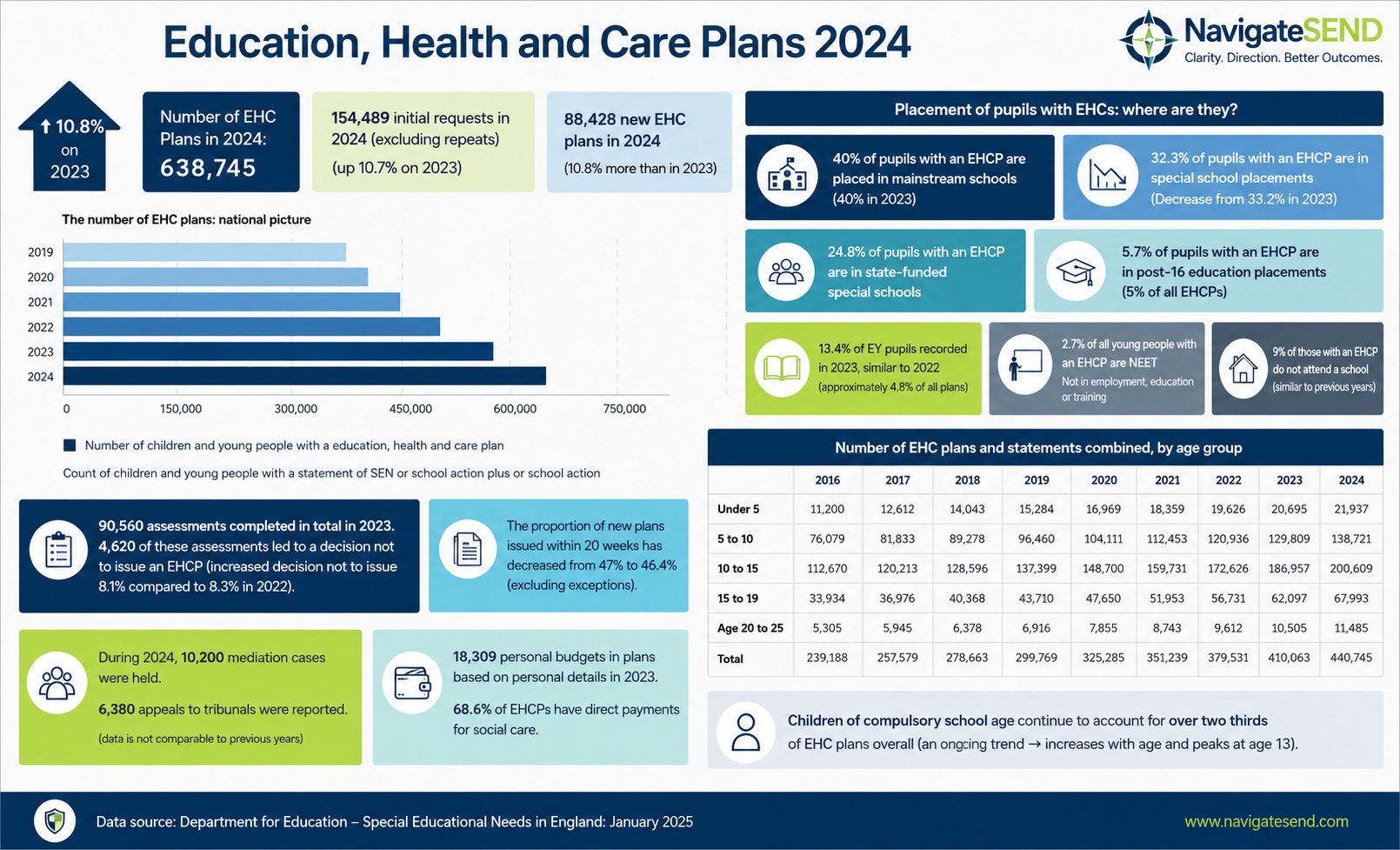 In England, the Department for Education reported 638,745 active Education, Health and Care Plans as at January 2025, a 10.8% increase on January 2024. It also reported 154,489 requests for EHC needs assessments during 2024, with only 46.4% of new plans issued within the 20-week statutory timeframe, excluding exceptions.
The National Audit Office reported that demand for EHC plans increased by 140% between 2015 and 2024, reaching 576,000 children and young people with plans in 2024.
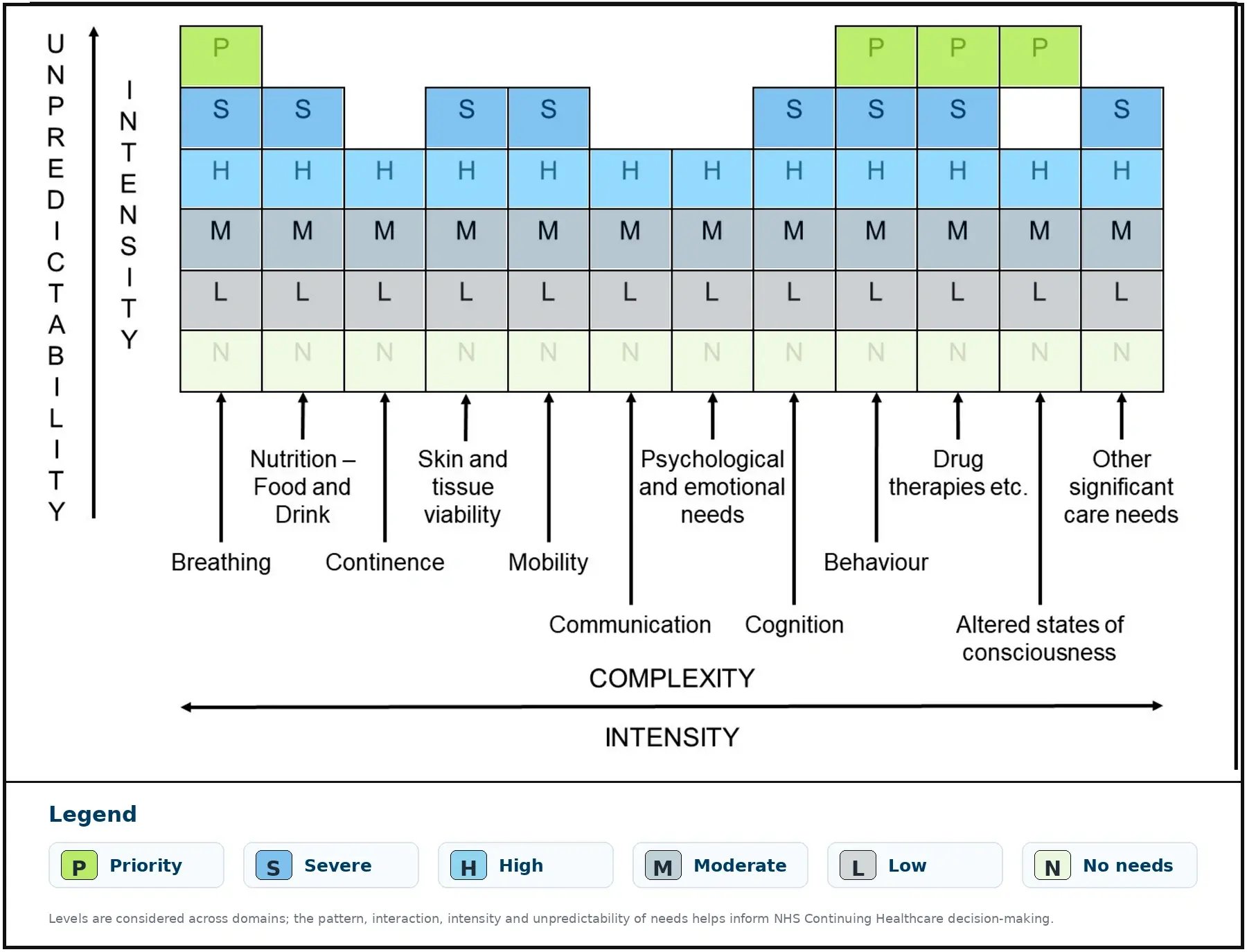
Adult care and health funding systems are also complex. NHS England reported 50,753 people eligible for NHS Continuing Healthcare at the end of Q3 2025/26, with 46,628 new CHC referrals in that quarter alone. The Local Government and Social Care Ombudsman reported that in 2024–25 it upheld 78% of investigated adult social care complaints, and that delays in assessment and poor communication remained key themes.
For deputies, this creates a real risk:
Client funds may be used to pay for support that should have been assessed, funded or jointly funded by a statutory body.
Our role is to reduce that risk.
What we help deputies achieve
Our statutory funding support is designed to help deputies:
- identify possible NHS, local authority, education or joint-funding duties;
- avoid unnecessary use of private funds where statutory funding may apply;
- understand whether current provision is correctly funded;
- evidence need clearly and professionally;
- prepare for CHC, Care Act, EHCP, EOTAS, social care or transition processes;
- coordinate professional evidence from education, health, psychology, care and rehabilitation;
- support best-interests decision-making;
- create a clear record for deputyship files;
- know when a matter should be escalated to a solicitor or formal legal challenge.
We do not simply ask, “What does the client need?”
We ask:
What does the client need, who should provide it, who should fund it, and what evidence is needed to secure it?
Our specialist statutory funding review
A statutory funding, benefits and grants review looks at the client’s current needs, current provision, existing funding arrangements, benefit position and possible public funding routes.
This may include NHS funding, local authority duties, EHCP or EOTAS provision, adult social care, section 117 aftercare, Access to Work, Disabled Students’ Allowance, disability benefits, home adaptation grants, equipment routes and other support that may reduce unnecessary pressure on private funds.
The aim is to help deputies understand what should be privately funded, what may be publicly funded, what evidence is needed, and when legal or specialist benefits advice may be required.
|
Statutory funding area
|
What we review
|
Why this matters for deputies
|
|---|---|---|
|
NHS Continuing Healthcare |
We review whether the person’s needs may require consideration under the NHS Continuing Healthcare framework. NHS CHC is an ongoing package of health and social care arranged and funded solely by the NHS where an adult has a primary health need. |
Deputies may need to avoid using private funds for care that should be considered under NHS CHC. We help identify evidence gaps, prepare for assessments, review previous decisions and consider whether further challenge or legal advice may be needed. |
|
NHS-funded Nursing Care |
Where a person is in a nursing home, we consider whether NHS-funded Nursing Care is relevant and whether CHC should have been properly considered first. |
Deputies may need to understand whether the person is on the correct NHS funding route, especially where nursing needs sit alongside wider complex health and care needs. |
|
Children and Young People’s Continuing Care |
For clients under 18, we review whether complex health needs may require consideration under the children and young people’s continuing care framework. |
CHC applies to adults, but children and young people may have a separate continuing care route where needs cannot be met by universal or specialist health services alone. This is important for deputies managing cases involving childhood injury, disability or transition. |
|
Personal Health Budgets |
Where NHS funding is relevant, we consider whether a personal health budget or direct payment route may support more flexible provision. |
Adults eligible for NHS CHC have a legal right to have a personal health budget. This may help deputies structure support around the person’s needs rather than defaulting to private arrangements. |
|
Care Act assessment and adult social care |
We review whether local authority adult social care duties may apply, including assessment, eligible needs, care planning, personal budgets, direct payments, charging issues and the relationship between private funds and public duties. |
This helps deputies understand whether the local authority should be assessing, planning, funding or contributing to support before private funds are used. The Care Act statutory guidance confirms that local authorities must meet eligible needs where the relevant conditions are met. |
|
Section 117 aftercare |
Where a person has been detained under relevant sections of the Mental Health Act, we review whether section 117 aftercare may be relevant. |
Some aftercare support should not be treated as privately chargeable. Deputies may need help identifying whether support is being incorrectly funded from the client’s estate. |
|
EHCPs, SEND and EOTAS |
For children and young adults up to 25, we review whether education, therapy, social care, health provision, transport or bespoke Education Otherwise Than At School provision should be requested, specified or delivered through an EHCP. |
Deputies may need to ensure that education, therapy and support are not being paid privately where they should be included in an EHCP or delivered through statutory provision. The SEND Code of Practice applies to children and young people aged 0 to 25. |
|
Transition to adulthood |
For young people approaching adulthood, we consider the overlap between children’s services, EHCPs, adult social care, NHS funding, mental capacity, care planning, benefits and long-term support. |
Transition is a high-risk point where funding responsibilities can become unclear. We help deputies plan ahead and avoid gaps between children’s and adult services. |
|
Therapy, psychology and rehabilitation funding |
Where therapies or psychological input are being funded privately, we review whether there is a statutory route that should be considered, whether the EHCP or care plan is incomplete, or whether further evidence is needed. |
This helps deputies decide whether therapy and rehabilitation should remain privately funded, be requested through statutory services, or be supported by stronger evidence. |
|
Transport, support workers and access to education |
We consider whether transport, support workers, personal assistance or access arrangements may fall within education, social care, health, Access to Work, DSA or joint-funding duties. |
These costs can be significant over time. Deputies may need support to clarify whether they should be privately funded or requested through a statutory, benefits or grant route. |
|
Access to Work |
Where a protected party is working, self-employed, starting work, preparing for work or attending interviews, we review whether Access to Work may be relevant. |
Access to Work can help a disabled person get or stay in work and may provide grants for practical support, mental health support or communication support at interviews. This can be important where private funds are being used for job coaching, travel, support workers, equipment or workplace adjustments. |
|
Disabled Students’ Allowance |
For students in higher education, we review whether Disabled Students’ Allowance may be relevant for study-related support, specialist equipment, software, non-medical help or travel linked to disability. |
DSA can cover study-related costs arising from disability, long-term illness, mental health difficulty or another condition. It is based on individual need, not household income, and does not have to be repaid. This may prevent education-related support being paid unnecessarily from private funds. |
|
Disability Living Allowance, Personal Independence Payment and Attendance Allowance |
We review whether the client’s disability-related benefits position should be checked, including DLA for children, PIP for people aged 16 and over before State Pension age, and Attendance Allowance for people of State Pension age or older. |
These benefits may provide regular income towards the extra costs of disability. DLA is now generally for children under 16, while people over 16 are usually directed towards PIP; Attendance Allowance is for people of State Pension age or older and does not cover mobility needs. |
|
Universal Credit, ESA and wider disability-related benefits |
Where relevant, we consider whether a specialist benefits check is needed for Universal Credit, New Style ESA or other disability-related financial support. |
Deputies should know whether the person is receiving the benefits they may be entitled to, particularly where private funds are being used to meet disability-related living costs. GOV.UK lists a wide range of disability-related benefits, payments, grants and concessions. |
|
Disabled Facilities Grant |
We review whether home adaptations, access works, level-access showers, ramps, stairlifts, heating controls or other adaptations may fall within Disabled Facilities Grant or local authority adaptation routes. |
Adaptations can be expensive. A Disabled Facilities Grant may help with the cost of making changes to the home so the person can continue to live there, and GOV.UK states that the grant will not affect benefits. |
|
NHS wheelchair services and personal wheelchair budgets |
We consider whether mobility equipment should be referred through NHS wheelchair services or whether a personal wheelchair budget may be relevant. |
Deputies may otherwise fund equipment privately without checking NHS assessment routes. NHS guidance says a GP, physiotherapist, occupational therapist or hospital staff member can refer to local wheelchair services for assessment, and some people may be eligible for a personal wheelchair budget. |
|
Blue Badge and mobility-related concessions |
We review whether practical access routes such as a Blue Badge, travel concessions or parking support should be considered. |
These may not replace major care funding, but they can reduce everyday costs, improve access and support independence. A Blue Badge can be applied for by the person, someone else, or an organisation. |
|
Equipment, adaptations and assistive technology |
We review whether equipment, technology or adaptations should be considered through the NHS, local authority, EHCP, DSA, Access to Work, Disabled Facilities Grant or private funding. |
Deputies often face pressure to approve private spending on equipment. The key question is whether the item is health-related, educational, employment-related, care-related, housing-related or genuinely private. |
|
Mixed or joint funding |
We review cases where more than one body may have responsibility, including NHS, local authority, education, social care, employment and private funding routes. |
Complex cases rarely fit neatly into one system. Deputies need a funding map that shows what should be requested, what evidence is missing, what can be privately funded, and what may require legal advice. |
Why deputies choose NavigateSEND
This service is led by a rare combination of professional expertise across education, psychology, SEND, statutory systems and complex case management.
Our statutory funding work is informed by experience as a:
- DfE-registered teacher;
- SENCO;
- headteacher;
- HCPC-registered psychologist;
- BABICM-registered complex case-management professional;
- IRCM-registered case-management professional.
That combination matters because statutory funding cases often fail when the evidence is too narrow.
A CHC case may need clear functional, health and risk evidence.
A Care Act case may need careful analysis of eligible needs, outcomes and the sustainability of support.
An EHCP or EOTAS case may need a precise understanding of education law, special educational needs, therapy evidence, school duties, social care input and preparation for adulthood.
A deputyship case may need all of these areas to be brought together in a way that supports best-interests decision-making and protects the client’s long-term funds.
Our strength is not just knowing one system.
It is understanding how the systems connect.
The outcome: better funding decisions and stronger evidence
Our work helps deputies move from uncertainty to a clear, evidence-based position.
Before a deputy commits private funds, we help answer:
- Has the right statutory assessment been requested?
- Is the care package correctly funded?
- Should CHC, Care Act support, section 117 aftercare, EHCP provision or EOTAS be considered?
- Is the local authority or NHS body relying on incomplete evidence?
- Is the EHCP specific enough?
- Is provision actually being delivered?
- Is therapy being treated as private when it should be specified in an EHCP?
- Is the client’s private award or estate being used before statutory duties have been properly explored?
- Is a legal opinion or formal challenge now required?
The result is a clearer funding strategy, a stronger evidence base and better protection for the protected party’s long-term interests.
When a deputy should request a statutory funding review
A review may be helpful where:
- a protected party’s care package is being paid privately;
- the client has complex disability, brain injury, autism, learning disability, mental health needs or SEND;
- CHC has been refused, reduced or withdrawn;
- NHS-funded Nursing Care has been offered but CHC may not have been properly considered;
- adult social care has not assessed the person fully;
- the local authority says support must be privately funded;
- an EHCP does not include the therapy, education, transport or social care provision required;
- EOTAS may be needed because school or college is not suitable;
- a young person is moving from children’s services to adult services;
- a deputy is concerned that private funds are being used too quickly;
- a family and deputy disagree about what should be funded;
- the case involves personal injury, clinical negligence, compensation or long-term damages;
- the deputy needs a clear report before deciding whether to involve solicitors.
Statutory funding routes we review
|
Area of need |
Possible statutory route |
What we help clarify |
|---|---|---|
|
Complex health and care needs |
NHS Continuing Healthcare |
Whether there may be a primary health need and what evidence is missing |
|
Nursing needs |
NHS-funded Nursing Care |
Whether CHC should have been considered first |
|
Daily care and support |
Care Act 2014 |
Eligible needs, care planning, personal budgets, direct payments and charging |
|
Mental health aftercare |
Section 117 aftercare |
Whether support should be non-chargeable aftercare |
|
Education and therapy under 25 |
EHCP |
Whether provision is specified, quantified and being delivered |
|
Bespoke education |
EOTAS |
Whether education otherwise than at school should be considered |
|
Therapy and rehabilitation |
EHCP, NHS, social care or private funding |
Whether therapy is educational, health, care-related or privately commissioned |
|
Transport |
SEND transport or adult transport duties |
Whether transport is a statutory responsibility |
|
Transition to adulthood |
EHCP, Care Act, NHS and MCA planning |
How children’s and adult systems should connect |
|
Accommodation-related support |
Social care, housing and deputyship planning |
Whether care and housing decisions are aligned with statutory duties |
How the process works
|
Step |
What happens |
What this gives the deputy |
|---|---|---|
|
1. Initial professional consultation |
We begin with a focused consultation to understand the client’s needs, diagnosis, current provision, deputyship context, private funding arrangements and immediate concerns. |
A clear starting point, including the main funding concerns, risks, priorities and whether a statutory funding review is appropriate. |
|
2. Document review |
We review relevant documents, which may include care plans, EHCPs, annual review paperwork, CHC checklists or Decision Support Tools, social care assessments, therapy reports, psychology reports, school or college correspondence, invoices and funding records, local authority or NHS decisions, and solicitor correspondence where relevant. |
A structured understanding of what has already been assessed, funded, refused, delivered or missed. |
|
3. Needs and funding map |
We map the client’s needs against possible statutory duties and identify where private funding may be appropriate, where public funding may be relevant, and where the evidence is incomplete. |
A practical funding map showing which needs may fall to private funds, the NHS, local authority, education system or joint-funding routes. |
|
4. Recommendations |
We provide practical recommendations. These may include requesting assessment, seeking review, gathering further evidence, asking for provision to be specified, escalating non-delivery, preparing for CHC, requesting Care Act input or seeking legal advice. |
Clear next steps that help the deputy decide what to do, what to request, what to evidence and when to involve legal advice. |
|
5. Written report for deputyship records |
Where required, we provide a written report that can support deputy decision-making, professional discussion and best-interests records. |
A clear written record to support defensible decision-making, professional liaison and best-interests planning. |
What deputies receive
Depending on the instruction, deputies may receive:
- statutory funding audit;
- written funding review;
- needs and provision map;
- EHCP, EOTAS or SEND review;
- CHC evidence summary;
- Care Act funding analysis;
- therapy and education provision review;
- transition planning review;
- recommendations for further assessment;
- professional chronology;
- decision-support note for deputyship records;
- referral recommendation where legal advice is needed.
Working alongside solicitors and professional teams
We work with financial deputies, Court of Protection solicitors, personal injury and clinical negligence teams, community care solicitors, education solicitors, families, schools, colleges, therapists, psychologists, social workers and case managers.
We do not replace legal advice.
Where a case requires formal legal challenge, Court of Protection advice, judicial review, community care law advice, SEND tribunal advice or litigation strategy, we work alongside the appointed legal team or recommend that legal advice is obtained.
Our role is to provide specialist assessment, evidence review, statutory funding analysis and practical recommendations so that deputies can make better-informed decisions.
Why this is different from general funding advice
Many funding problems are not purely legal, purely educational, purely medical or purely financial.
They are cross-system problems.
A young adult with an acquired brain injury may need an EHCP, therapy, social care, mental capacity planning, transport, care support, psychology, vocational planning and preparation for adulthood.
An adult with complex disability may need a CHC review, Care Act assessment, personal budget review, risk assessment, psychology input and a properly evidenced care package.
A child with SEND may need EOTAS, therapy, specialist teaching, social care, transport and health provision, all coordinated around an EHCP.
A protected party with a personal injury award may still have statutory rights that need to be identified before private funds are used.
Our service is designed for precisely these overlaps.
A professional evidence-led approach
Deputies need advice they can rely on.
Our work is:
- evidence-based;
- outcome-focused;
- professionally regulated;
- grounded in education, psychology, SEND and case-management practice;
- focused on statutory duties and practical provision;
- clear about professional boundaries;
- designed to support defensible deputyship decisions.
The HCPC regulates practitioner psychologists and protects designated psychological titles, requiring registrants to meet professional standards. BABICM promotes excellence in brain injury and complex case management for adults, children and young people, while IRCM maintains a voluntary register for case managers who meet eligibility requirements and commit to professional standards.
This matters because statutory funding decisions can have long-term consequences for a protected party’s care, independence, education, rehabilitation and financial security.
Common outcomes from a statutory funding review
A review may identify that:
- CHC should be requested or reconsidered;
- a previous CHC decision needs closer scrutiny;
- a care package may require local authority assessment;
- an EHCP is too vague or incomplete;
- therapy should be specified and quantified;
- EOTAS may be appropriate;
- social care input has been missed;
- transport duties need to be considered;
- statutory bodies need to coordinate around the client;
- private funding is appropriate but should be clearly justified;
- legal advice is needed before escalation.
We cannot guarantee that statutory funding will be awarded.
We can help deputies understand the evidence, strengthen the application and make better-informed decisions about next steps.
FAQ's
Can a financial deputy request statutory funding support?
Yes. A financial deputy can seek specialist professional input where it helps them make informed, proportionate and best-interests decisions about the protected party’s funds, care, education or support.
Can statutory funding still apply if the client has private funds or compensation?
Potentially, yes. Private funds do not automatically remove statutory duties. The correct position depends on the funding route, the person’s needs, the applicable legal framework and any financial assessment rules.
Can you help with NHS Continuing Healthcare?
Yes. We can review care and health needs, identify evidence gaps, support preparation for CHC assessment or review, and help deputies understand whether specialist legal input may be required.
Can you help with Care Act funding?
Yes. We can review whether adult social care assessment, eligible needs, care planning, personal budgets, direct payments or charging issues need to be addressed.
Can you help with EHCPs and EOTAS?
Yes. This is a core area of expertise. We can review whether education, therapy, health, social care, transport or EOTAS provision should be requested, specified or delivered through an EHCP.
Do you work with adults as well as children?
Yes. We support statutory funding issues involving children, young people and adults, particularly where SEND, disability, care, rehabilitation, psychology, transition and deputyship overlap.
Do you replace solicitors?
No. We do not replace legal advice. We provide expert statutory funding review, evidence analysis and practical recommendations. Where legal advice or formal challenge is required, we work alongside solicitors.
What is the main benefit for deputies?
The main benefit is clarity. Deputies receive a professional view on what may be privately funded, what may be a statutory responsibility, what evidence is needed and what steps should be taken next.
Request a statutory funding review
If you are a financial deputy, Court of Protection solicitor, family deputy or professional adviser, we can help you understand whether statutory funding routes have been properly considered.
We can review the case, identify possible funding responsibilities, advise on evidence and provide practical next steps.