Our SEND Support Services

Psychology, advocacy and case-navigation for SEND, education, study, work and adulthood

NavigateSEND provides specialist SEND advocacy, psychological assessment, case-navigation and evidence-informed planning for families, young people and professionals.

We help when needs are not being understood, EHCPs are unclear, provision is not being delivered, school is breaking down, or further evidence is needed to support education, study, work, independence or adulthood planning.

This page helps you find the right service route, whether you need advocacy, psychological assessment, behaviour support, capacity assessment, Access to Work, DSA evidence or ongoing strategic advice.

Not sure where to start?

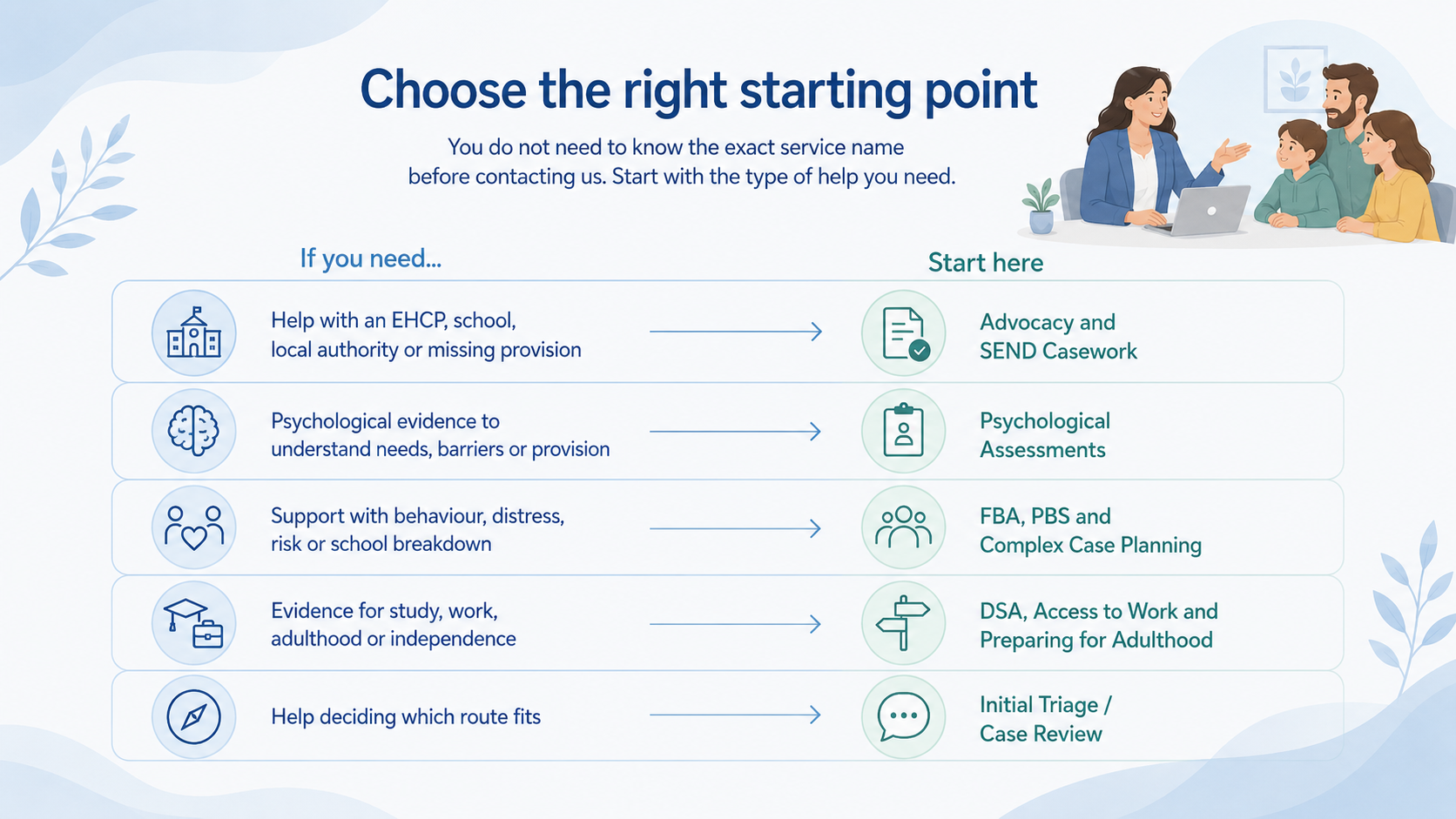
If you are unsure which service applies, start with the route that best matches the current problem:

  • You need to request an EHCP for the first time
  • An existing EHCP no longer reflects need
  • An annual review is coming up or has gone badly
  • Support in the EHCP is not actually being delivered
  • You need to make a clear request to the local authority
  • The case needs more than one stage of ongoing support

All service areas

Advocacy, EHCP and SEND casework

If you need help or support with an EHCP, School, Local Authority or missing provision then advocacy and SEND casework will be your most likely service need.

EHCP annual reviews

Structured support before, during and after annual review, including identifying issues, organising evidence and clarifying the strongest next step.

BEST FOR:  Annual reviews that need clearer preparation, stronger evidence or more strategic follow-through.

Requests to local authorities for provision

Help structuring clear requests and setting out what is needed, why it is needed and what evidence supports it.

BEST FOR:  Targeted requests that need to be communicated in a clearer, more strategic way.

EHCP provision not being delivered

Support where agreed SEND provision is not being made, is inconsistent, or is not meeting need in practice.

BEST FOR:  Cases where support exists on paper but not in reality, or where delivery has broken down.

Ongoing SEND strategic advisory

Retained support for complex, evolving or multi-stage cases where continuity, planning and oversight are important over time.

BEST FOR:  Complex cases that require more than one intervention or sustained strategic support.

EHCP needs assessment requests & reassessments

Support with preparing and structuring requests for an Education, Health and Care needs assessment, including evidence review, strategic framing and next-step planning.

Best for: new EHCP requests, reassessment requests, and situations where the need for formal assessment needs to be set out clearly.

EHCP amendments

Support when an EHCP needs to be updated so that needs, provision or outcomes better reflect the current picture.

Best for:  plans that are outdated, incomplete, unclear or no longer appropriate.

Psychological assessment and evidence

If you need psychological evidence and an evaluation to understand needs, barriers or provision then a psychological assessment will help.

Psychological assessments

Use this if you need psychological evidence to better understand a child, young person or adult’s needs, strengths, barriers, learning, functioning, independence, study or work-related support needs.

Our assessments are designed to support practical decision-making, provision planning, EHCP discussions, preparation for adulthood, education, study, work or wider case planning.

Best for: families and professionals who need clearer evidence, recommendations or formulation.

EHCP-focused psychological assessment

Assessment and reporting focused on identifying special educational needs, barriers to learning, provision requirements and recommendations that may support EHCP discussions.

Best for: draft EHCPs, weak EHCPs, reassessments, annual reviews or cases where psychological evidence is needed.

Educational Needs and Learning Profile assessment

Assessment of learning, cognitive profile, strengths, barriers, study skills and educational support needs.

Best for: children or young people whose learning needs are unclear, misunderstood or not fully reflected in current planning.

EOTAS and School Breakdown Formulation

Psychology-informed review where school attendance, placement suitability or access to education has become difficult or has broken down.

Best for: school refusal, EBSA, failed placements, alternative provision or EOTAS planning.


Preparing for Adulthood Assessment

Assessment and recommendations focused on independence, further education, training, employment, life skills and future support needs.

Best for: young people approaching adulthood, post-16 planning, college transitions, independence planning or EHCP outcomes.


Specialist assessments and support plans

If you need something more specific, for example:

  • Support with behaviour that challenges, distress, risk or school breakdown, then Functional Behavioural Assessment, Positive Behaviour Support Planning (PBS) or Complex Case Planning will help; or,

  • Evidence for study, work, adulthood or independence then a Disability Support Allowance (DSA), Disability Living Allowance (DLA), Access to Work (A2W) or Preparing for Adulthood (PfA) assessment will help.

Functional Behavioural Assessment and Positive Behaviour Support

Use this if behaviour is creating concern, distress, risk or placement instability.

We use Functional Behavioural Assessment to understand what behaviour may be communicating, what triggers or maintains it, and what support may reduce distress. Positive Behaviour Support focuses on practical strategies, environmental changes, communication, regulation and consistency.

Best for: distressed behaviour, meltdowns, shutdowns, aggression, self-injury, school breakdown, exclusions, risk concerns or behaviour linked to unmet SEND needs.

Decision-specific capacity assessment

Assessment focused on whether a person can make a particular decision at a particular time, where this falls within our professional scope.

This may involve understanding the decision, the information relevant to it, the person’s ability to weigh information, communicate a choice, and the support needed to maximise participation.

Best for: clearly defined decisions relating to education, care, support, independence, work or future planning.

DSA Evidence and Study Support assessment

Assessment and evidence to support Disabled Students’ Allowance, study support, reasonable adjustments and learning access in higher education.

Best for: students or prospective students who need evidence of study-related barriers, support needs, assistive technology or learning adjustments.


Access to Work and Workplace Adjustments Assessment

Assessment and recommendations focused on work, vocational functioning, reasonable adjustments, support needs and Access to Work planning.

Best for: young people or adults entering work, returning to work, changing role, or needing evidence for workplace support.

Exam access arrangements and reasonable adjustments

Assessment and advice relating to learning access, processing, written output, attention, fatigue or other barriers that may affect exams or assessments.

Best for: pupils or students where access arrangements may be required, usually alongside school or college processes.


Case Management

When education, health, care, therapy and funding responsibilities overlap, families and professionals often need someone to bring the whole picture together. NavigateSEND provides specialist case management for children, young people and adults with complex SEND, disability, rehabilitation, education and care needs.

Our case-management work focuses on clarity, coordination and outcomes: understanding the person’s needs, identifying the right professionals, mapping evidence, clarifying responsibilities and helping turn recommendations into a practical plan.


Statutory Case Management

For families, deputies and professionals who need help navigating EHCPs, EOTAS, Care Act support, NHS Continuing Healthcare, Disabled Students’ Allowance, Access to Work, disability benefits, transport, therapy provision and transition to adulthood.

This route is suitable where the key issue is:

  • what support is needed;
  • which statutory body or funding route may be responsible;
  • what evidence is missing;
  • what should happen next.

Litigation Case Management

For solicitors, case managers, deputies and litigation teams working with clients after brain injury, complex injury, clinical negligence, acquired disability or long-term rehabilitation need.

This route is suitable where the key issue is:

  • coordinating rehabilitation and support;
  • linking therapy, education, care and vocational goals;
  • supporting interim or long-term planning;
  • reviewing provision and outcomes;
  • helping the professional team understand what the client needs now and next.


Not sure which service fits?

Integrated SEND and Psychology Case Review

Use this if the situation is complex and you are not sure whether you need advocacy, psychological assessment, EHCP review, FBA/PBS, EOTAS planning, DSA, Access to Work or another route.

We review the key issues, consider the current evidence, identify gaps, and help you decide what the most appropriate next step should be.

Best for: families and professionals dealing with overlapping concerns, unclear evidence, school breakdown, missing provision, EHCP issues, behaviour concerns, transition planning or multiple agencies.



Start with the service that best matches the problem you are trying to solve now

If more than one seems relevant, or the case is evolving across several stages, get in touch and we can help identify the most appropriate route.Find the right SEND support

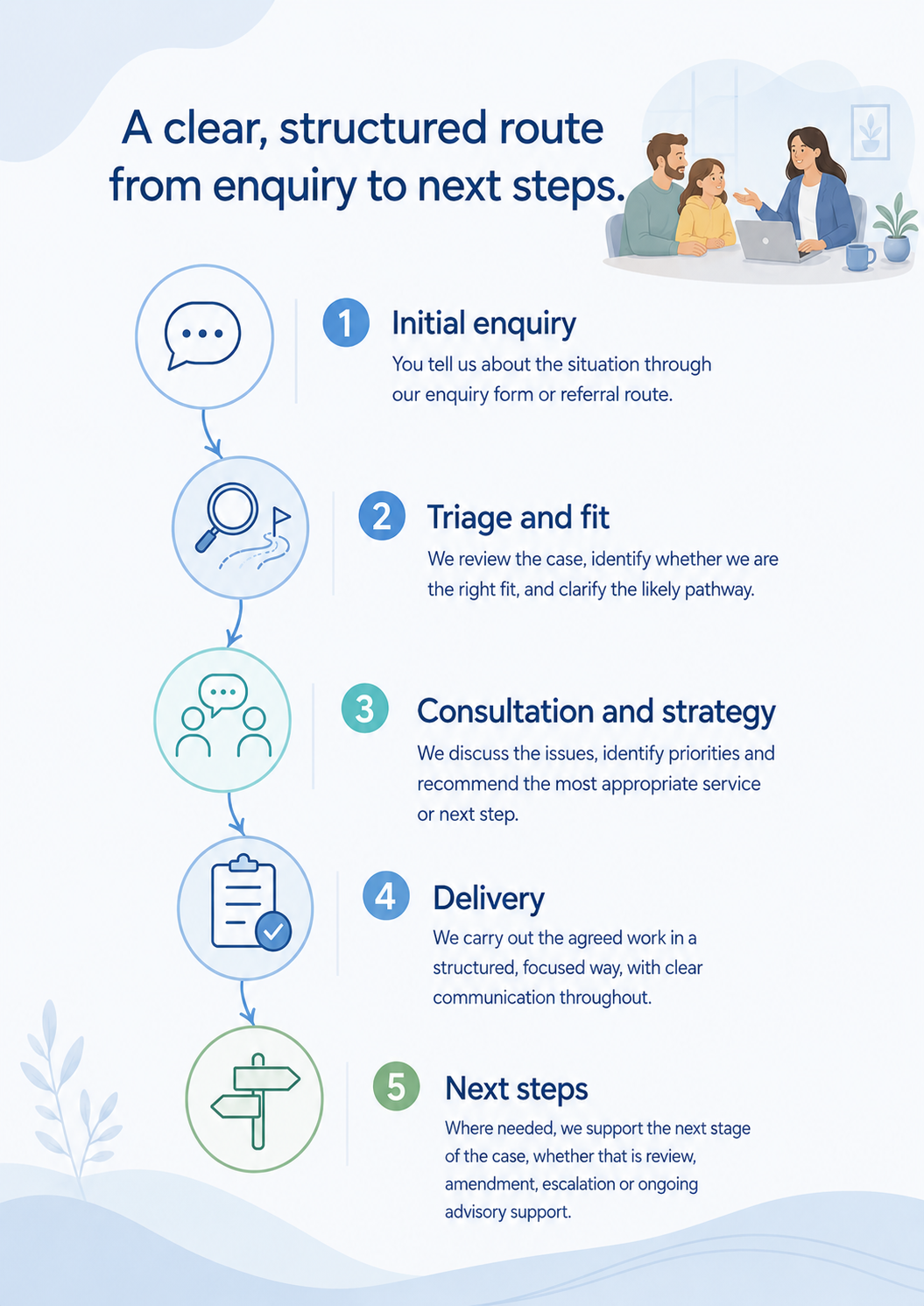
Navigate SEND Steps

Need help with an urgent provision or EHCP issue?


If provision is not being delivered, a deadline is approaching, or you are unsure what to do next, get in touch and tell us what is most urgent.


Built around real search intent and real case stages

Problem-led

Each service corresponds to a common point where families and professionals actively seek help.


Clearer choice

People can identify the service that best matches their immediate issue without reading endless general copy.


Better follow-through

Each service page can explain what it covers, who it is for, what happens next and how to enquire.


Supports growth

The structure can expand later with resources, FAQs, case examples and deeper sub-pages without losing clarity.

Common questions about our services
What if I am not sure which service applies?

That is common. Start with an enquiry or consultation and we can help identify the most appropriate route based on the current stage of the case.

Can one case involve more than one service?

Yes. Some cases move from one stage to another, such as an EHCP request followed by review, amendment or ongoing strategic advisory support.

Do you work with both families and professionals?

Yes. Families are the primary audience and case managers are the secondary audience in the current model.

 
Can I contact you before deciding which service I need?

Yes. If the position is unclear or urgent, it is often better to start with a discussion than to guess the route alone.

Do you provide both advocacy and psychological assessment?

Yes. Some families need advocacy or casework. Others need psychological assessment or evidence. Some need both. We will help identify which route is most appropriate.


Can you help if we are not sure whether we need an assessment?

Yes. Many families are unsure whether the issue is evidence, EHCP wording, missing provision, school placement, behaviour, anxiety, learning or preparation for adulthood. We can help you decide the next step.

Do you provide clinical diagnosis?

NavigateSEND’s core work is educational, occupational, SEND-related and functional. We do not present our service as a medical, clinical or neuropsychological diagnostic service unless this has been specifically arranged through an appropriately qualified professional.

Can you support DSA or Access to Work?

Yes. Where appropriate, we can provide assessment and recommendations relating to study support, workplace adjustments, vocational functioning, DSA or Access to Work.

Can professionals refer to NavigateSEND?

Yes. We accept enquiries from families, schools, case managers, deputies, solicitors and other professionals where the work falls within our scope.


NEED HELP CHOOSING THE RIGHT ROUTE?

If you are dealing with a complex or urgent SEND situation, the simplest route is to get in touch so we can help identify the strongest next step.

You can also use our checklists, to see if you have everything you need.

We look forward to hearing from you.