
Evidence review
Review of relevant background information, school context, reports and case materials already available.
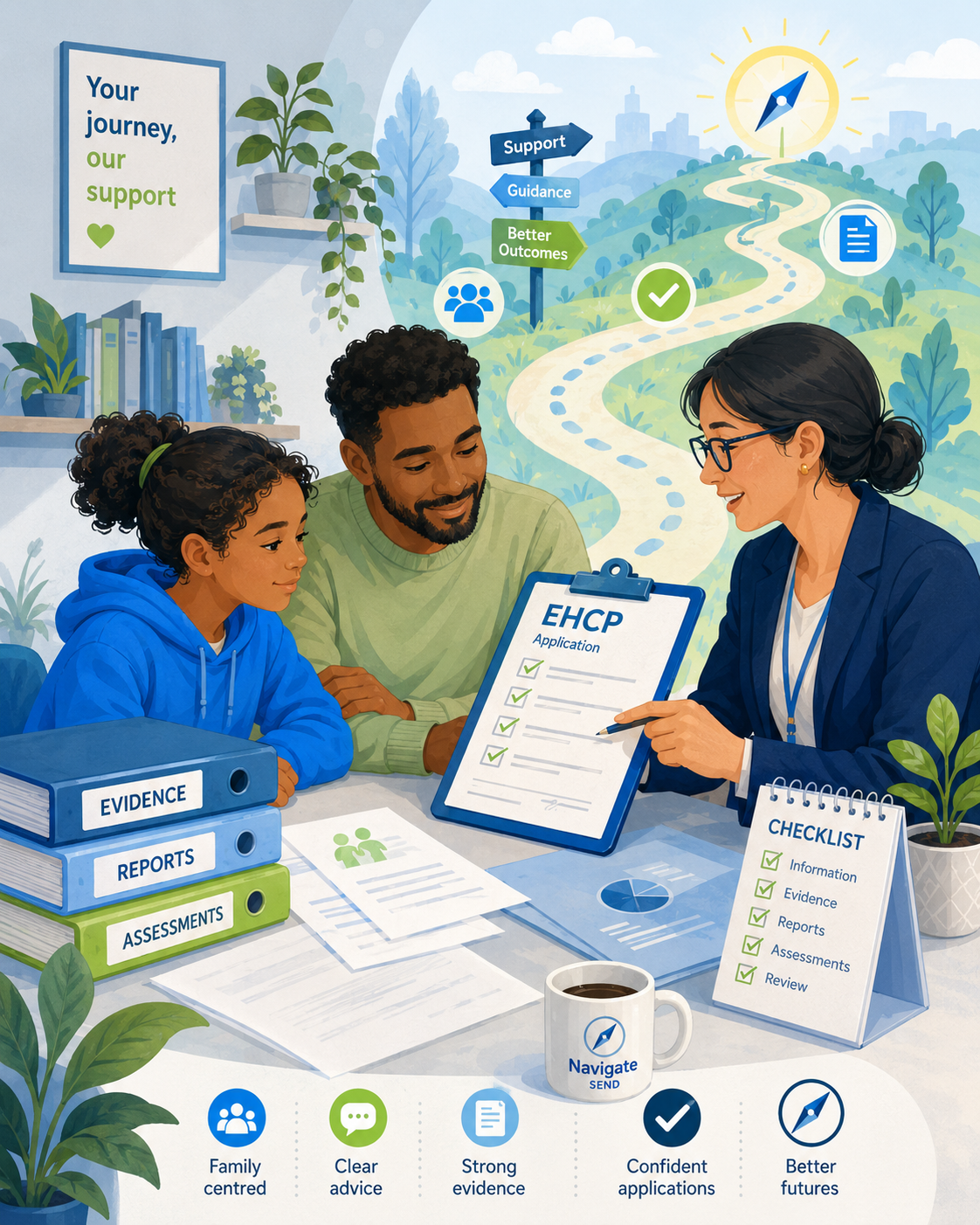
Applying for an EHCP formally begins by asking your local authority to carry out an Education, Health and Care needs assessment, often shortened to an EHC needs assessment or EHCNA.
Navigate SEND helps families, young people and professionals organise the evidence, explain the educational impact of the child or young person’s needs and prepare a clear, structured request.
We can support:
The aim is not simply to produce a longer application. It is to make the evidence easier to understand and connect it directly to the decision the local authority must make.
To apply for an EHCP, a parent, young person or education setting asks the child or young person’s local authority to carry out an EHC needs assessment.
The request should explain:
The local authority does not decide at this first stage whether the final EHCP should definitely be issued. It decides whether the evidence meets the threshold for carrying out the assessment.
Parents can make the request directly. A young person aged 16 to 25 can also request an assessment for themselves. A school or post-16 setting may make a request, while other professionals can bring the child or young person to the local authority’s attention and contribute supporting evidence.
The request should normally be sent to the SEND or statutory assessment team for the local authority responsible for the child or young person.
Local authorities may provide an online portal or their own request form. Check the local process, but focus on ensuring that the information addresses the statutory decision rather than treating the form as a simple administrative exercise.
State expressly that you are requesting an Education, Health and Care needs assessment.
Include:
Explain why the child or young person:
Provide the documents that best demonstrate the needs, educational impact, support already attempted and remaining gaps.
A focused evidence pack is usually more useful than a large collection of records with no explanation of why each document matters.
Keep:
The receipt date is important because it starts the statutory timetable.
The local authority must secure an EHC needs assessment where, after considering the views and evidence submitted, it is of the opinion that:
the child or young person has or may have special educational needs; and
it may be necessary for special educational provision to be made through an EHC plan.
This is deliberately a test about what may be the case.
At this stage, you are not required to prove the final wording of an EHCP or establish beyond doubt that a plan must be issued. The request should show why a full statutory assessment may be necessary to understand the child or young person’s needs and determine the provision required.
What this means in practice
A strong request should help the local authority understand:
Local forms, panel criteria and evidence checklists may help organise the information, but the central question remains the statutory two-part test.
No.
It is often helpful to work with the school, nursery or college because the setting may hold important evidence about:
However, a parent can make a direct request even where the school does not agree that an assessment is required. Young people aged 16 to 25 may also make a request themselves.
Where the setting does not support the application, it becomes particularly important to explain clearly:
A confirmed diagnosis is not part of the statutory test for deciding whether to carry out an EHC needs assessment.
The test asks whether the child or young person has or may have special educational needs and whether provision through an EHC plan may be necessary.
Diagnostic or medical evidence can be useful where it helps explain functioning or educational impact, but the application should not rely on a diagnostic label alone.
The more important questions are:
The statutory wording therefore allows assessment to be considered where needs are suspected but not yet fully identified.
No.
There is no statutory rule requiring a school to spend a particular amount—often described as £6,000—before an EHC needs assessment request can be made.
Evidence of the support already provided is relevant and can help demonstrate why further assessment may be necessary. However, the decision must remain needs-led and based on the statutory test, rather than on whether a particular spending threshold has first been reached.
Similarly, there is no universal legal rule requiring a fixed number of assess–plan–do–review cycles before a parent or young person can make a request. Evidence from those cycles can be valuable, but a request may still be appropriate where needs are complex, provision is breaking down or the setting cannot identify or provide what is required.
The strongest evidence depends on the individual case.
Useful material may include:
The child or young person’s views
Information about:
Parent or carer evidence
A concise description of:
Evidence from the education setting
This may include:
Professional reports
Relevant reports may come from:
A clear chronology
A short chronology can help show:
Evidence of educational impact
Educational impact is broader than academic attainment.
It may include the effect of needs on:
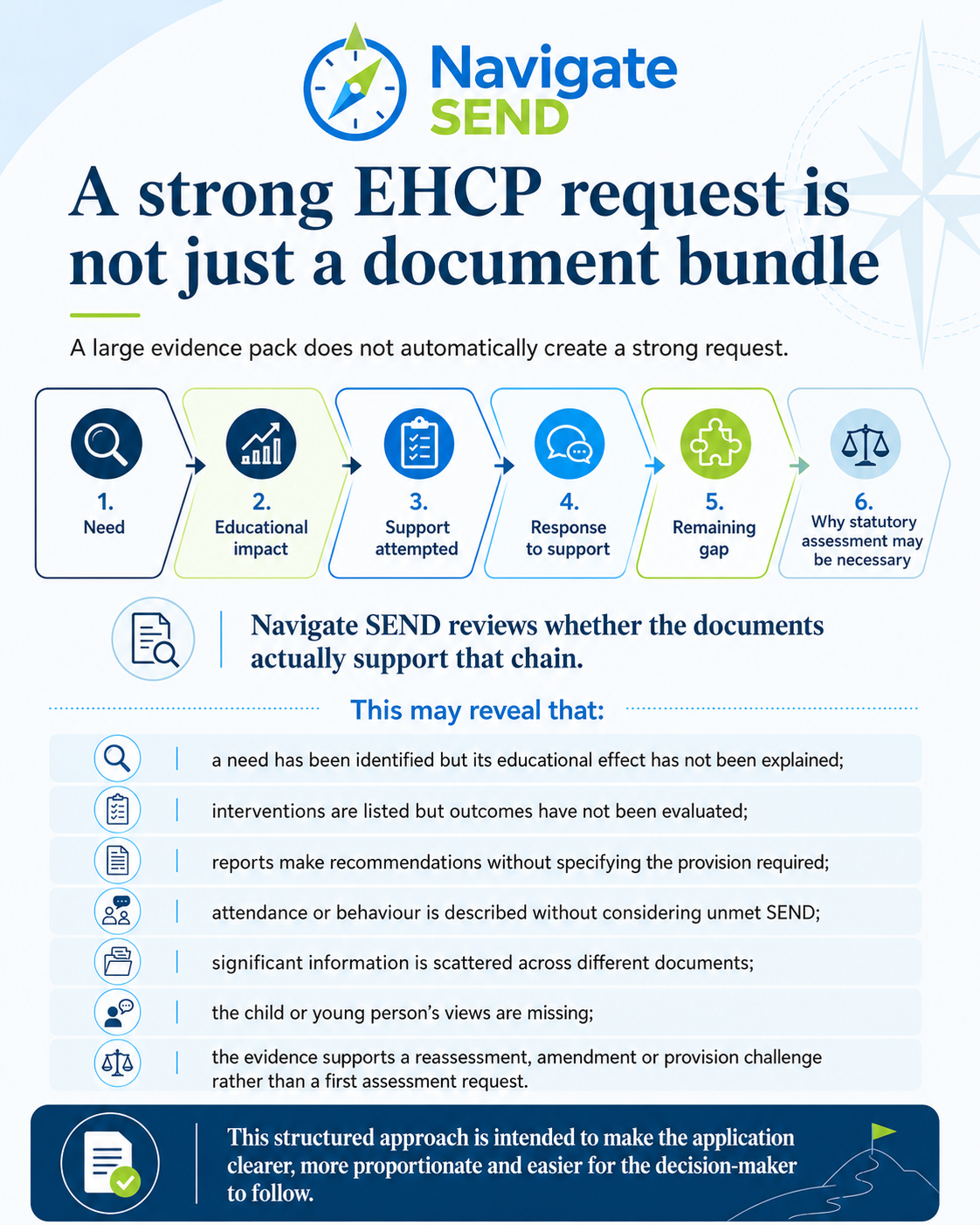
Initial suitability and pathway review
We first establish:
Evidence review
We review the relevant information already available and identify:
Strategic case formulation
We organise the case around:
Drafting the request
Where included in the agreed scope, Navigate SEND prepares or supports the preparation of a structured EHC needs assessment request.
The document can bring together:
Evidence mapping and gap analysis
We identify what each report contributes and whether further evidence may be useful.
This does not mean commissioning every possible assessment. Further work should be linked to a genuine unanswered question.
Early local authority correspondence
Where agreed, the service may include support with early correspondence following submission or in response to a request for further information.
Next-step planning
At the conclusion of the work, we clarify what happens next, including:
This develops the same core service already offered on the existing page—evidence review, strategic framing, drafting support, gap spotting and follow-through planning—but makes the process and deliverables clearer.
The precise output depends on the agreed scope, but may include:
The scope, timescale and fee are confirmed before substantive work begins.

Review of relevant background information, school context, reports and case materials already available.
Clarifying the core case picture, what matters most, and how the request or reassessment should be positioned.
Support with drafting or structuring the request, associated covering content and next-step materials where agreed.
Identifying where the current evidence is strong, where it is weak, and where further material may be useful.
Helping families and professionals understand the pathway, likely sequencing and practical next steps.
Clarifying what to do next once the request or reassessment work has been completed.
Navigate SEND guided tool
Use this simple checker to see whether the family can address both parts of the legal test, what information and evidence they already have, and what may still need to be gathered.
Legal content checked: 24 August 2026
Step 1
These questions identify whether the family should prepare a new request, add information to an existing request, use an appeal route or seek urgent help alongside the EHC process.
Step 2
The family should be able to connect a difficulty or disability to an educational effect and to provision that is additional to or different from ordinary provision. A diagnosis is not required.
The request should explain the need, the educational impact and the provision or assessment it calls for.
Step 3
The family should show what support is or was available, whether it was delivered, the child or young person’s response, and what difficulty remains. There is no fixed number of support cycles that must be completed first.
Step 4
The request should explain why the required provision may need to be identified, coordinated, specified or secured through an EHC plan rather than left solely to ordinary SEN Support.
The request does not have to prove at this stage that a plan definitely is necessary.
Step 5
Mark whether each useful item is held, can be obtained, is unavailable or is not relevant. The list adapts to the needs, impacts and reasons selected earlier.
Step 6
The traffic lights assess completion of the legal questions and evidence checklist. They do not predict the local authority’s decision or guarantee that an EHC plan will be issued.
This contains no personal details. Copy it into the family’s working notes and use it to plan the actual request.
Your readiness summary will appear here.
An EHCP needs assessment request is a request asking the local authority to carry out an Education, Health and Care needs assessment where a child or young person may need special educational provision through an EHCP.
Yes. Navigate SEND can support reassessment or re-framing work where a previous request has not moved forward and the evidence or strategy needs strengthening.
Background information, school history, current concerns, relevant reports and any previous correspondence or decisions are usually the most useful starting materials.
Yes. Families are the primary audience, and case managers and other professionals can also use this service where the case and referral route are appropriate.
An Education, Health and Care plan is a statutory plan for a child or young person who requires special educational provision to be made through an EHC plan.
It identifies relevant needs, outcomes and provision, together with the educational placement and other information required by the statutory framework.
No.
The EHC needs assessment is the assessment process. The EHCP is the statutory plan that may be issued after that assessment.
An assessment does not automatically result in an EHCP.
Yes.
A parent can request an EHC needs assessment directly from the local authority. The school does not have to make the application on the parent’s behalf.
No.
A school can express its view, but it cannot remove a parent’s right to make a direct request to the local authority.
Yes.
A young person aged 16 to 25 can request an EHC needs assessment themselves.
The relevance of education or training becomes particularly important for older young people.
No confirmed diagnosis is required by the statutory assessment test.
Diagnostic evidence may be helpful, but the key questions concern possible special educational needs, educational impact and whether provision through an EHC plan may be necessary.
Not necessarily.
Special educational needs can affect communication, attendance, participation, regulation, sensory or physical access, independence and the ability to engage with education, as well as academic attainment
No.
There is no statutory £6,000 spending requirement that must be met before an EHC needs assessment can be requested.
The local authority normally has six weeks from receiving an initial request to decide whether it will carry out the EHC needs assessment.
Yes.
A local authority can decide not to assess or, following an assessment, decide not to issue an EHCP. Those decisions carry rights of appeal.
A previous refusal does not permanently prevent a further request.
The appropriate next step may be an appeal, a new request with additional evidence or another form of professional support. The decision letter and relevant deadlines should be reviewed before choosing the route.
A reassessment is a fresh statutory assessment for a child or young person who already has an EHC plan.
It may be required where needs have changed significantly or the existing evidence is no longer sufficient to identify the provision required.
No.
An annual review examines whether the existing plan remains appropriate. A reassessment gathers new education, health and care assessment advice.
An annual review can sometimes identify that a reassessment should be requested.
No.
The decision belongs to the local authority and may ultimately be challenged through the statutory appeal process. Navigate SEND’s role is to improve the clarity, structure and evidential basis of the request.
No.
Navigate SEND provides psychological, educational, SEND and case-analysis support. We do not provide legal representation or determine the outcome of an appeal.
If you want a clearer, more structured route into this stage of the SEND process, get in touch and we can help identify the strongest next step.
You can also use our checklists, to see if you have everything you need.
We look forward to hearing from you.