What happens in SEND Tribunal placement appeals?

Matt Bell
SEND Tribunal placement appeals are becoming more common because the pressure on school places is increasing. Families are being told that mainstream inclusion is the direction of travel, while mainstream schools may say they cannot meet need, specialist placements may not be available, and children with Education, Health and Care Plans (EHCPs) may be left without a workable placement.
This guide explains what is happening, what the law actually says about naming schools and colleges in EHCPs, why placement disputes are growing, and how Navigate SEND supports families and professionals through the process.
The short answer
A SEND Tribunal placement appeal is usually about Section I of an EHCP: the school, college, type of setting, or absence of a named placement. It may arise when a final or amended EHCP names the wrong placement, names only a type of setting, leaves Section I blank, or follows a refusal to amend after annual review where the family believes the placement must change.
The Tribunal does not simply choose the “best” school. It looks at needs, provision and placement in that order. A placement appeal is strongest when Sections B and F clearly show what the child or young person needs, and why the requested setting can deliver that provision while the local authority’s proposal cannot.
Why placement appeals are becoming more visible
The public context has changed quickly. The 2026 Schools White Paper and related SEND reform consultation place a strong emphasis on mainstream inclusion, Individual Support Plans and new layers of support within ordinary settings. (gov.uk) The government has said EHCPs will remain for children who need more than routinely available mainstream support, but the reform direction has understandably made families anxious about whether specialist placements will become harder to secure. (commonslibrary.parliament.uk)
The data shows why families are feeling the pressure. DfE statistics recorded 718,800 active EHC plans in January 2026, a 12.5% increase from January 2025 and the highest year-on-year increase since EHCPs were introduced. (explore-education-statistics.service.gov.uk) In 2026, 326,800 children and young people with EHCPs attended mainstream schools, representing 45.5% of all EHCPs. The proportion attending special schools has continued to fall as a share of all EHCPs, from 38.6% in 2019 to 29.4% in 2026, even though the actual number in special schools has risen.
The pressure is also visible outside ordinary school placements. In 2026, 62,400 children and young people with EHCPs were recorded as attending placements other than school, early years or further education. This was 8.7% of all EHCPs, up from 3.3% in 2019. Within that category, 16,000 were in alternative arrangements made by the local authority, including education otherwise than at school (EOTAS), and 22,000 were not in education, employment or training. (nao.org.uk)
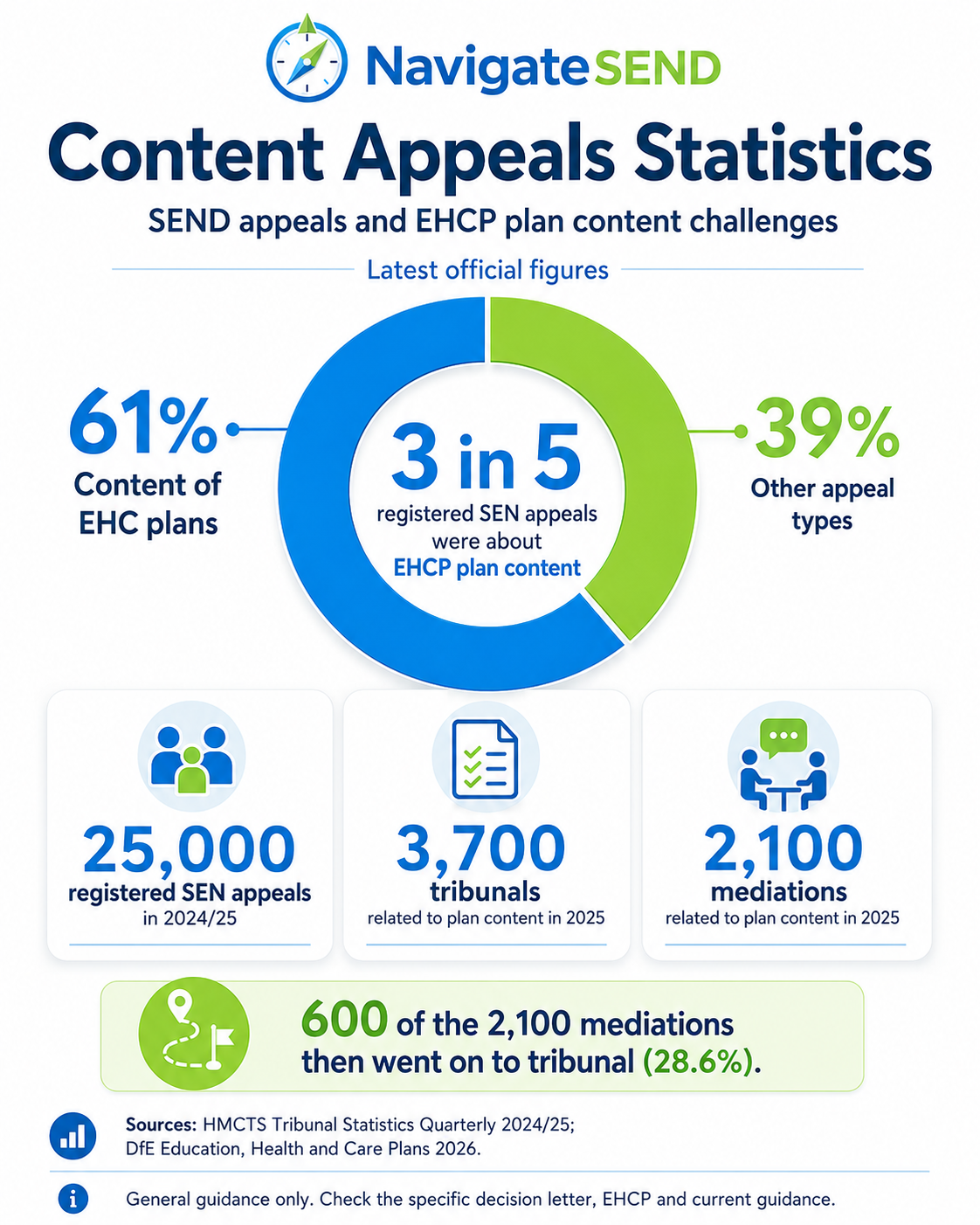
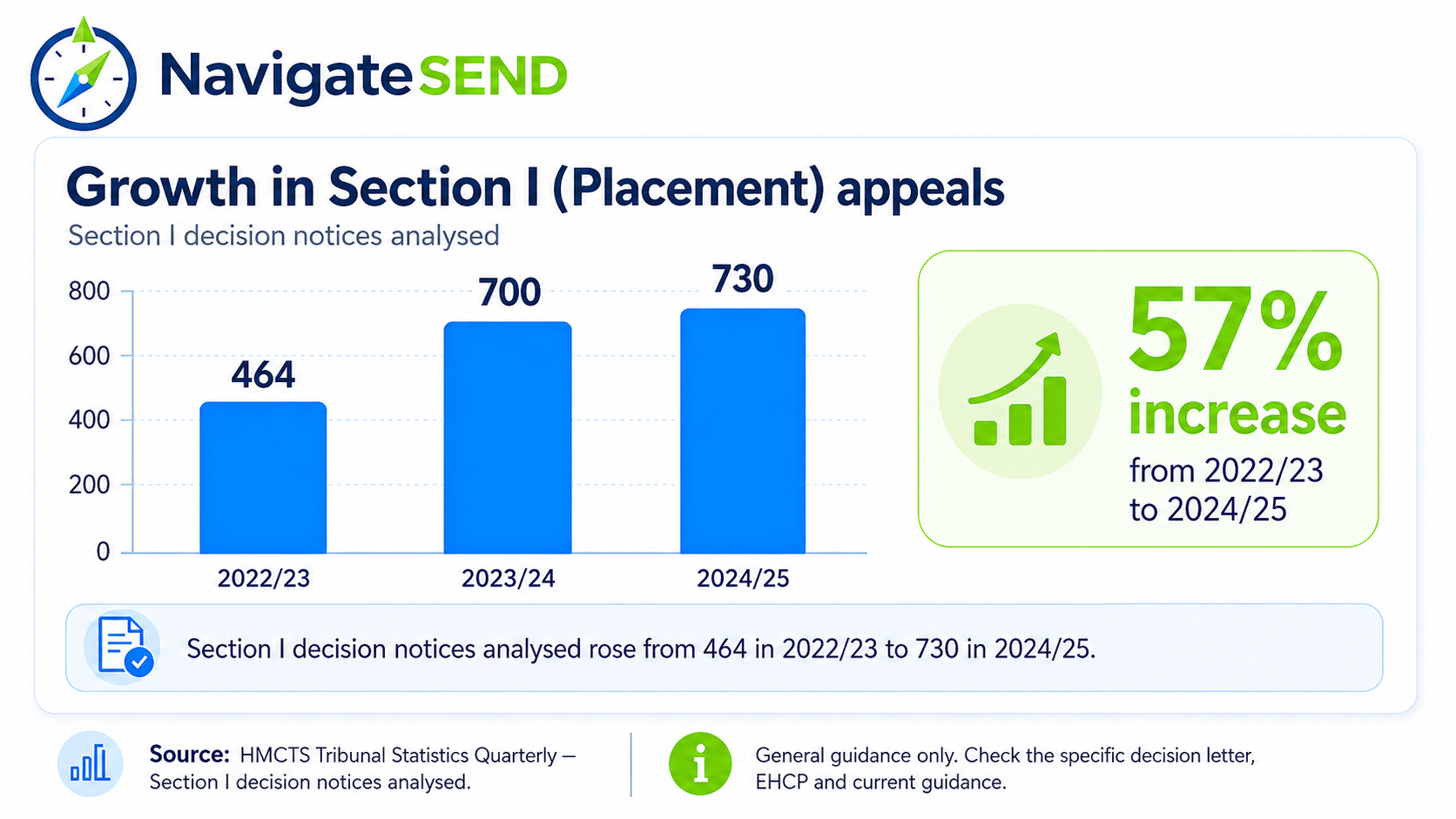
Tribunal figures show the same pattern of strain. HMCTS recorded 25,000 registered SEN appeals in 2024/25, an 18% increase on the previous year. Of these, 61% related to the content of EHC plans, which includes needs, provision and placement. HMCTS also analysed 730 Section I decision notices for 2024/25: 31% resulted in the parent preference, 24% resulted in parent and local authority preference, and 13% resulted in the local authority preference. (gov.uk)
What the law says about naming a school or college
Parents and young people can request certain types of school or institution to be named in an EHCP. This includes maintained schools, academies, further education institutions, non-maintained special schools and institutions approved under section 41 of the Children and Families Act 2014. (gov.uk)
Where the request is for one of those types of setting, the local authority must name it unless it can show one of the statutory exceptions applies. (legislation.gov.uk) The requested setting may be refused if it is unsuitable for the child or young person’s age, ability, aptitude or special educational needs, or if attendance would be incompatible with the efficient education of others or the efficient use of resources.
This is an important distinction. “The school is full” is not automatically the legal test. A school being under pressure may be relevant, but the real question is whether admitting this child or young person would create the statutory incompatibility, and whether the evidence supports that. The local authority must also consider the placement in the context of the needs and provision in the EHCP.
Once a school or institution covered by the duty is named in the EHCP, it will usually have a duty to admit. (legislation.gov.uk) That is why Section I matters so much. The wording of the final EHCP is not just administrative; it can determine whether the child has an enforceable route into the setting.
How mainstream inclusion affects placement disputes
Inclusion should mean that children and young people can access education with the right support, in the right environment, and with provision that is actually delivered. It should not mean placing a child in mainstream simply because there is no specialist place available. (legislation.gov.uk)
Many families support the idea of strong mainstream inclusion. The fear is that mainstream schools are being asked to support increasingly complex needs without enough specialist staff, space, therapy input, training, sensory provision or time. Families may then be told that special school is not available, out-of-county provision is too expensive, or mainstream should be tried again, even after repeated breakdowns.
This is where Section I appeals become difficult. A mainstream school may say it cannot meet need. The local authority may still say mainstream is appropriate, perhaps with additional funding or support. The family may believe only a special school, specialist college or out-of-county placement can meet the child’s needs. The Tribunal will usually need evidence about the child’s needs, the provision required, what the proposed mainstream setting can realistically deliver, and why the requested setting is suitable.
Why B and F usually matter before Section I
A placement appeal is rarely just about the name of the school. It is usually also about whether the EHCP properly describes the child or young person’s needs and provision.
Section B describes special educational needs. Section F specifies special educational provision. Section I names the school, college or type of setting. The usual order is needs first, provision second, placement third.
If Section B misses key needs, the plan may understate the level of support required. If Section F is vague, a mainstream school may appear more suitable on paper than it really is. If Section F says only “access to support” or “regular adult input”, it may be impossible to test whether a setting can actually deliver the provision.
For that reason, many Section I appeals should also include Sections B and F. The uploaded placement appeal module makes the same point: Section I alone is often insufficient because the plan must first identify all special educational needs, then the provision required to meet them, and only then the setting able to deliver that provision.
What if there is no special school place available?
A shortage of places does not make the child’s needs disappear. If the EHCP requires specialist provision, the local authority still has to make a lawful decision about the placement and ensure suitable education is available in the meantime.
If the child is of compulsory school age and is not receiving suitable education because of exclusion, illness, placement breakdown or another reason, the local authority may need to consider alternative education duties. The SEND Tribunal may decide what should be named in the EHCP, but it is not usually the route for day-to-day complaints about missed education while placement discussions continue. (lgo.org.uk)
The Local Government and Social Care Ombudsman has publicised cases where children with SEND missed education because of council delay or bureaucracy. In one 2025 Trafford case, a child who could not attend mainstream missed months of education despite a tutor and special school places being identified. The Ombudsman said the child should have missed, at most, two weeks after the emergency review, but internal bureaucracy added months of avoidable delay. (lgo.org.uk)
What can be requested in a SEND Tribunal placement appeal?
Depending on the appeal, families may ask the Tribunal to order changes to Section I, such as naming a particular school, naming a particular college, changing the type of setting, removing an unsuitable placement, or specifying that education should take place otherwise than at school or college where the legal test is met.
Families may also ask for changes to Sections B and F so that the needs and provision properly support the placement request. This might include more specific therapy, specialist teaching, adult support, sensory provision, behaviour or regulation support, medical support, travel training, or a structured package for a young person whose course is not full time.
For independent schools that are not non-maintained special schools or section 41 approved institutions, consent from the setting will usually be needed before the Tribunal can name it. Families should be clear which type of setting they are requesting, because the legal route and evidence may differ.
What evidence helps a placement appeal?
The most useful evidence links the child or young person’s needs to the provision required and then to the placement capable of delivering it.
Helpful evidence may include:
- the current final EHCP and any proposed amended EHCP;
- annual review papers and phase transfer documents;
- school consultation responses;
- professional reports from educational psychology, speech and language therapy, occupational therapy, physiotherapy, specialist teaching, CAMHS or medical professionals;
- evidence from the current school about what has been tried and why it is not enough;
- attendance records, exclusion records, reduced timetable information or placement breakdown evidence;
- information from the requested school or college, including how it would meet need;
- cost information, transport information and details of any alternative provision;
- the child or young person’s views where appropriate.
A placement appeal should not rely only on the family’s understandable belief that a school feels right. It should show, through evidence, why the requested placement is suitable and why the local authority’s proposed placement is not suitable or not workable.
How Navigate SEND supports placement appeals
Navigate SEND helps families and professionals organise placement disputes so that the case is clear, evidence-led and focused on the legal tests.
We can help by:
- reviewing Sections B, F and I together;
- identifying whether a refusal-to-amend appeal should include placement, needs and provision;
- checking whether the current EHCP is specific enough to test placement suitability;
- preparing questions for school consultations and visits;
- organising professional evidence around suitability, provision and placement;
- helping families compare mainstream, resourced, special, independent and out-of-county options;
- supporting working document preparation;
- helping families understand when interim education, complaint or separate legal routes may be needed.
The aim is not to argue for special school in every case. The aim is to identify the setting that can actually deliver the provision required and support the child or young person to access education, make progress and be safe. For families juggling more than one SEND issue at once, this can extend into ongoing strategic advisory support.
Questions families often ask
Can I appeal if the EHCP names the wrong school?
Yes. If a final or amended EHCP names a school or college you disagree with, or names only a type of setting, you may be able to appeal to the SEND Tribunal about Section I. It is often sensible to consider whether Sections B and F also need to be appealed.
Can a local authority say a special school is full?
Capacity can be relevant, but “full” is not usually enough by itself. The issue is whether admitting the child would meet one of the statutory exceptions, and whether the evidence supports that conclusion.
What if mainstream says it cannot meet need?
Ask for the reasons in writing and compare them with the EHCP. If mainstream cannot deliver the provision required, the plan may need amendment, additional support, or a different placement.
Can the Tribunal order an out-of-county placement?
Yes, if the legal test is met. The fact a school is outside the local authority area is not, by itself, a reason to refuse it. The Tribunal will consider suitability, efficient education of others and efficient use of resources.
Can Navigate SEND help if my child has no placement?
Yes. Navigate SEND can help clarify the current legal route, organise evidence, prepare questions for the local authority, and identify whether the issue is a Tribunal appeal, annual review, complaint, interim education or a wider strategy.
Next step
If your child or young person’s EHCP does not name a suitable placement, or mainstream and specialist options are breaking down, Navigate SEND can help you review the evidence, understand the legal tests and prepare the strongest next step.