
SEND appeal and tribunal preparation
EHCP appeal evidence, working document and hearing preparation

A SEND Tribunal appeal is easier to manage when the decision being challenged, the outcome required and the evidence supporting each issue are organised clearly from the beginning.
Navigate SEND supports parents, young people and professional teams preparing appeals about Education, Health and Care needs assessments and Education, Health and Care Plans.
We can help clarify the issues in dispute, organise the evidence, prepare a chronology, review the EHCP working document, identify evidence gaps, coordinate professional input and prepare for the hearing.
Navigate SEND is not a law firm. This service provides educational, psychological, SEND and case-preparation support. It does not include solicitor representation or legal advice.
Important deadline
A SEND Tribunal appeal must usually be received within two months of the date on the local authority’s decision letter, or one month from the date of the mediation certificate, whichever is later.
In most cases, the parent or young person must first contact a mediation adviser. The main exception is an appeal that is only about the school or other institution named in Section I of the EHCP.
If you have received a local authority decision, include the date of the letter in your first enquiry.
Can Navigate SEND help me prepare an EHCP appeal?
Navigate SEND can help you turn a large and sometimes confusing set of EHCP papers, professional reports, correspondence and school records into a structured appeal preparation plan.
The service may include:
- reviewing the local authority decision;
- identifying exactly what is being appealed;
- clarifying the changes or outcome being sought;
- preparing a concise chronology;
- organising the evidence around the disputed issues;
- reviewing or preparing proposed EHCP wording;
- supporting the working-document process;
- identifying whether further professional evidence is needed;
- planning witnesses and their areas of evidence;
- tracking tribunal directions and deadlines;
- preparing the family or professional team for the hearing.
The core service does not include legal representation. Where a solicitor, barrister or specialist legal adviser is involved, Navigate SEND can work alongside them by providing focused educational, psychological and SEND analysis.
What decisions can be appealed to the SEND Tribunal?
Which kind of appeal may apply?
The local authority refused to assess
The appeal asks the tribunal to order the local authority to carry out an EHC needs assessment.
The central issue is whether the child or young person has or may have special educational needs and whether it may be necessary for special educational provision to be made through an EHC plan.
The local authority assessed but refused to issue an EHCP
The appeal asks the tribunal to decide that an EHC plan is necessary.
The evidence needs to show why the child or young person requires special educational provision to be secured through a statutory plan rather than through ordinarily available SEN support alone.
The EHCP does not describe the needs accurately
The appeal may challenge Section B.
A strong case identifies:
- the need that is missing or inaccurately described;
- the evidence supporting that need;
- the effect of the need on education;
- the wording that should replace or supplement the existing wording.
The provision is vague, insufficient or incomplete
The appeal may challenge Section F.
The question is not simply whether the plan mentions a type of support. It is whether the provision is clear enough to be understood, delivered and monitored.
The evidence may need to address:
- what provision is required;
- who should deliver it;
- the required frequency;
- the duration and intensity;
- group size;
- professional qualification or expertise;
- how progress should be monitored;
- how the provision relates to the identified need.
The placement is disputed
The appeal may challenge Section I.
This can involve:
- the type of placement;
- the school or college named;
- a request for a particular institution;
- whether the proposed setting can actually deliver Section F;
- whether the placement is suitable for the child or young person’s age, ability, aptitude and special educational needs;
- the practical consequences of the proposed placement.
The local authority refused to amend the plan
An appeal may follow an annual review, reassessment or other decision where the local authority refuses to make requested changes.
The local authority decided to cease the EHCP
The appeal may challenge whether it remains necessary for the plan to be maintained.
For an older young person, the evidence may need to address continuing education or training, preparation for adulthood, independence, progression and the provision required to achieve the remaining outcomes.
What do I need to check before starting and appeal?
Check the decision letter
The local authority’s decision letter should identify:
- the decision made;
- the date of the decision;
- the right of appeal;
- mediation information;
- the relevant appeal arrangements.
Keep the original letter and record the date it was received.
Check the appeal deadline
The tribunal must usually receive the appeal within:
- two months from the date on the decision letter; or
- one month from the date of the mediation certificate,
whichever gives the later deadline.
Do not wait until the evidence pack is perfect before checking the deadline.
Contact the mediation service where required
In most EHC appeals, the parent or young person must contact a mediation adviser before lodging the appeal.
It is possible to obtain a mediation certificate without taking part in mediation. Mediation advice is not normally required where the appeal is solely about the institution named in Section I.
Decide what outcome is actually required
Before gathering more reports, identify:
- what decision is being challenged;
- what the current position is;
- what the tribunal is being asked to order;
- which EHCP wording is disputed;
- which placement is sought;
- what evidence supports each requested change.
Which SEND Tribunal form is used?
Refusal to carry out an EHC needs assessment
A refusal-to-assess appeal can be made through the online appeal service or using:
SEND35A is specifically for appealing a local authority decision not to secure an EHC needs assessment. The form and online route were updated in March 2026.
Most other EHCP appeals
Most other EHC needs assessment and EHCP appeals can be made online or using:
This includes appeals involving a refusal to issue a plan, disputed EHCP contents, reassessment, amendment or cessation decisions.
Changes after the appeal has been registered
Other forms may be required later. For example:
- SEND7 may be used to request a change, such as adding witnesses or changing a hearing arrangement;
- SEND8 may be used to withdraw an appeal.
The current SEND Tribunal forms collection should always be checked because procedural forms can be updated.
Navigate SEND can help organise the factual and professional information needed for the appeal. Where the case requires legal interpretation or formal legal submissions, advice should be obtained from a suitably qualified legal professional.
Navigate SEND guided tool
Prepare a SEND35 or SEND35A appeal
This guided tool has been designed to help you through the local authority decision, appeal deadline, disputed issues, grounds and evidence - it does not provide legal advice, guarantee that an appeal is valid or predict the Tribunal’s decision. Please, check the current HMCTS form and obtain individual advice where needed.
The final review identifies filing gaps and produces a preparation summary, for you to download.
The final review identifies filing gaps and produces a preparation summary, for you to download.
Your information stays in this browser tab.
Nothing entered here is deliberately submitted or stored in local storage. Please, copy or download the summary before closing or refreshing the page.
Step 1 of 7
14%
- Route
- Deadline
- Scope
- Grounds
- Evidence
- Details
- Review
Step 1
Find the correct appeal route
Start with the decision you have actually received. This determines whether SEND35, SEND35A, or another route is likely to apply.
This tool is not monitored and is not an emergency or safeguarding service.
Call 999 where there is immediate danger. For safeguarding concerns, contact the relevant local authority safeguarding service. Where education or EHC provision has stopped, obtain urgent advice about action needed alongside any tribunal appeal.
Step 2
Check the deadline and mediation position
The tool calculates an indicative deadline from the dates entered. Check the decision letter and mediation certificate before relying on it.
Likely route
No route selected yet
Select the local authority decision in Step 1.
Indicative appeal deadline
Enter the decision date
Not calculated
The usual calculation is not yet available.
The calculated date has passed.
A late appeal may still be accepted, but the Tribunal will need a clear explanation. Do not assume that a late appeal will be admitted.
Step 3
Define exactly what the Tribunal is being asked to decide
A focused appeal identifies each disputed decision or EHC plan section and the precise outcome sought.
Select a decision in Step 1 to see the available scope.
SEND35A issue
Refusal to secure an EHC needs assessment
The grounds should address whether the child or young person has or may have SEN, and whether it may be necessary for provision to be made through an EHC plan.
Section I: placement details
Health or social-care recommendations cannot stand alone in this process. Keep at least one valid educational appeal issue live.
Step 4
Build the grounds of appeal
For each issue, state what is wrong, why, what evidence supports you, and what exact action you want the Tribunal to take.
Select the decision and appeal scope to build the relevant grounds.
Step 5
Check the documents and map the evidence
The Tribunal needs the required filing documents. Persuasive grounds also link each disputed issue to clear, relevant evidence.
No documents are uploaded or sent by this module.
Mark what you have, what is being obtained, and what remains missing. Add the final documents to the official appeal submission separately.
Select an appeal route to generate the evidence checklist.
Evidence register
List the documents you intend to rely on and what each one proves.
Step 6
Collect the remaining form details
These fields help prepare the official form. Use initials and leave sensitive fields blank here if you would rather add them directly to the HMCTS form.
Child or young person
Appellant and contact details
Hearing and participation
Step 7
Review filing readiness and evidence gaps
This checks whether the core information has been assembled. It does not predict whether the appeal will succeed.
Readiness is not the same as prospects of success.
The quality, relevance and weight of the evidence—and the legal response to it—cannot be reduced to an automated score.
Critical checks and next actions
Evidence still being obtained or missing
Preparation summary
Copy this into a working document or use it for a professional review. It is not the official appeal form.
Your summary will appear here.
Before the appeal is lodged
- Transfer and check the answers against the current official SEND35 or SEND35A form.
- Complete the declaration and signature requirements on the official form.
- Attach every required filing document and the evidence being relied on.
- Number pages consistently and keep a copy of the complete appeal bundle.
- Keep proof of submission and record the date it was sent.
How Navigate SEND can help
1. Deadline and suitability review
We begin by reviewing:
- the local authority’s decision;
- the date of the decision;
- the mediation position;
- the appeal deadline;
- the nature of the disputed issue;
- whether tribunal preparation is the appropriate route.
Where the issue is instead about existing provision not being delivered, an overdue process or another administrative failure, we will distinguish that from an appeal about the plan or decision.
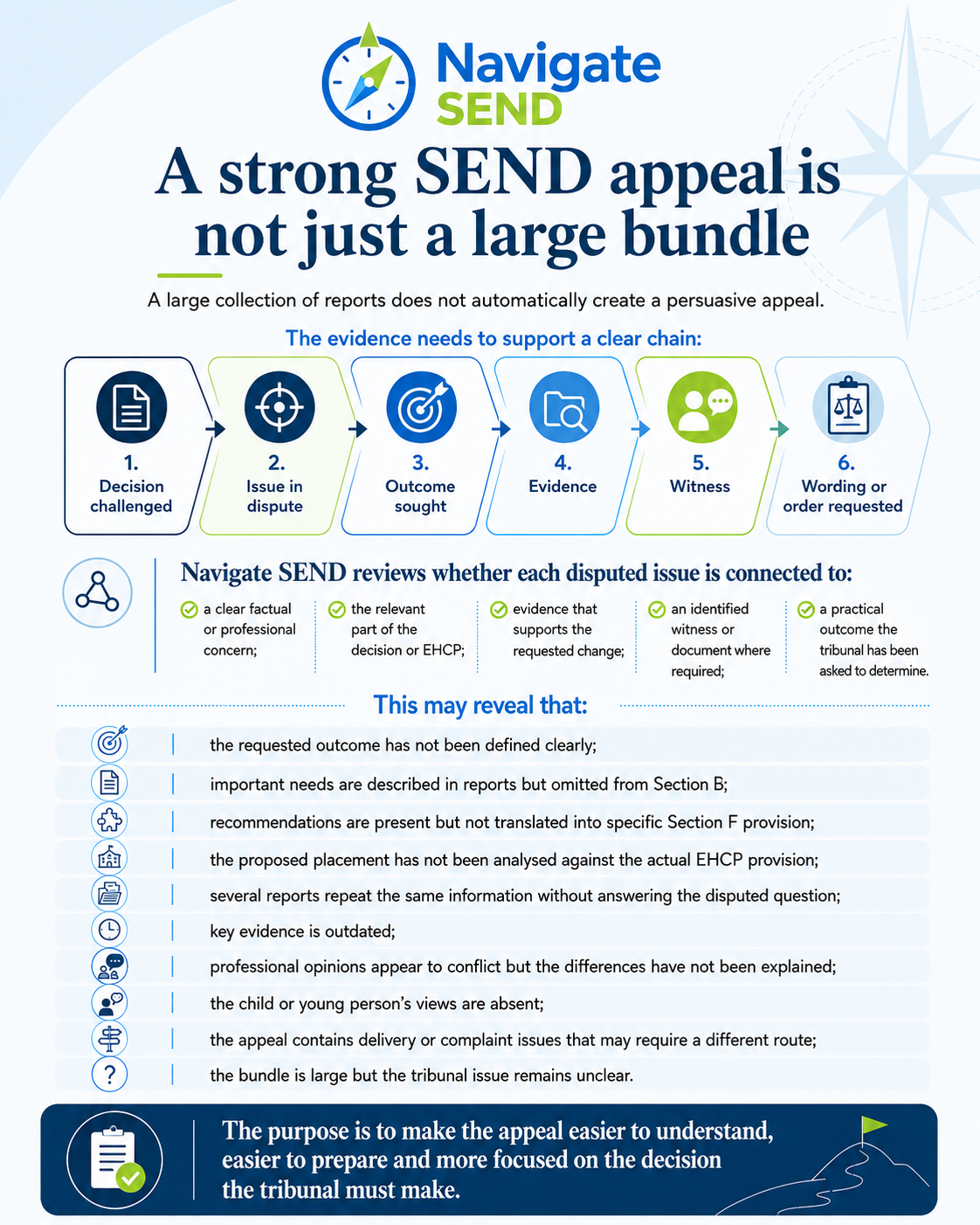
2. Appeal scope and issues map
We identify:
- the decision being challenged;
- each issue in dispute;
- the outcome sought;
- the relevant EHCP section;
- the evidence supporting the requested outcome;
- remaining evidence gaps.
This creates a concise appeal map that can guide the rest of the preparation.
3. Chronology
A tribunal chronology should identify the events that materially explain the appeal.
It may cover:
- when concerns first emerged;
- SEN support and interventions;
- assessments;
- changes in need;
- attendance or placement difficulty;
- annual reviews;
- professional recommendations;
- EHC assessment decisions;
- draft and final plans;
- local authority decisions;
- mediation;
- important developments after the appeal began.
A useful chronology is selective and evidential. It is not simply every email placed in date order.
4. Appeal statement and outcome sought
Navigate SEND can help structure a clear account of:
- what the local authority decided;
- why that decision is disputed;
- what the evidence shows;
- what change or order is being requested.
This is professional case-preparation support rather than legal advice. Where legal grounds or legal submissions require specialist input, they should be settled by the family’s solicitor or other legal adviser.
5. Evidence review and evidence map
We review whether the available material answers the actual tribunal questions.
Relevant evidence may include:
- the local authority’s decision letter;
- the current, draft or amended EHCP;
- Section K appendices;
- school or college records;
- SEN support plans;
- annual review papers;
- progress and attainment evidence;
- attendance information;
- reduced timetable records;
- professional reports;
- witness statements;
- placement information;
- costings;
- the child or young person’s views;
- correspondence relevant to the decision.
The tribunal bundle may include letters, emails, reports, statements, school information, examples of work, placement documents and other evidence already exchanged between the parties.
6. Evidence gap analysis
We identify whether further information is genuinely required.
This may include questions such as:
- Is there current evidence of need?
- Does the report explain educational impact?
- Are recommendations sufficiently specific?
- Is there evidence about the proposed placement?
- Does a professional need to clarify an earlier report?
- Is there evidence about what support has already been attempted?
- Is there a current account of the child or young person’s wishes?
- Is the evidence focused on the issue the tribunal must determine?
The aim is not to commission every possible assessment. Additional evidence should answer a defined question.
7. EHCP working document support
Where the contents of an EHCP are being appealed, the working document becomes a central part of the case.
The working document shows:
- the local authority’s current wording;
- wording agreed by both parties;
- wording proposed by the parent or young person;
- wording proposed by the local authority;
- the matters that remain for the tribunal to decide.
HMCTS describes the working document as the joint document showing the changes each party seeks or agrees and the remaining issues for the hearing.
Navigate SEND can help:
- review Section B for accuracy and completeness;
- connect each need to appropriate Section F provision;
- identify vague or unenforceable wording;
- review proposed outcomes;
- examine placement implications;
- compare the wording with professional recommendations;
- record agreed and disputed amendments consistently;
- keep the document focused on the live appeal.
The final agreed working document is normally sent to the tribunal before the hearing in accordance with the case directions; HMCTS guidance for local authorities refers to a final version at least ten working days before the hearing.
8. Professional evidence and witness planning
A witness should have a defined purpose.
We can help identify:
- what question each witness can answer;
- whether their written evidence is sufficient;
- whether clarification is needed;
- where two professional opinions differ;
- which witness knows the child or young person directly;
- which witness can explain the proposed placement;
- whether the evidence is current and within the witness’s expertise.
Witness planning may involve:
- a parent or young person;
- a SENCO or teacher;
- a therapist;
- a psychologist;
- a case manager;
- a placement representative;
- another professional with direct knowledge of the disputed issue.
9. Tribunal directions and case preparation
Following registration, the tribunal issues directions and key dates.
Preparation may include:
- creating a deadline tracker;
- reviewing the local authority response;
- identifying missing documents;
- preparing requests for changes where necessary;
- reviewing witness and attendance information;
- checking evidence submission dates;
- preparing for case-review stages;
- ensuring the working document remains current;
- coordinating the professional team.
The tribunal normally reviews the appeal and responds within 25 working days. It then sends the appeal to the local authority, which normally has 30 working days to respond. The exact timetable and evidence deadlines are set by the tribunal’s directions in the individual case.
10. Hearing preparation
We can help prepare:
- a concise case overview;
- the remaining issues in dispute;
- the outcome sought for each issue;
- a bundle-navigation guide;
- the key documents and page references;
- the role of each witness;
- questions the evidence may need to answer;
- points requiring clarification;
- a hearing-day checklist;
- reasonable-adjustment or communication considerations.
The aim is not to script every answer. It is to ensure that the evidence can be explained calmly, accurately and consistently.
11. Post-hearing review
Following the decision, support may include:
- reviewing what the tribunal ordered;
- comparing the order with the final EHCP;
- identifying implementation deadlines;
- checking whether further clarification or professional input is required;
- distinguishing implementation concerns from any potential review, set-aside or Upper Tribunal issue.
What will I receive?
The precise output depends on the appeal and the agreed scope.
A tribunal preparation package may include:
- an initial deadline and pathway review;
- an appeal issues matrix;
- a concise case chronology;
- an evidence index;
- an evidence-gap analysis;
- a structured case summary;
- support preparing the factual and professional basis of the appeal;
- a reviewed or developed EHCP working document;
- proposed Section B and Section F wording;
- a witness and professional-evidence plan;
- a tribunal directions tracker;
- a hearing preparation note;
- a bundle-navigation document;
- post-decision implementation guidance.
Before work begins, we confirm:
- what will be reviewed;
- what output will be produced;
- what is outside scope;
- the fee;
- the timescale;
- whether any meeting or hearing attendance is included.
What this service does not include
Navigate SEND is not a law firm.
The core tribunal preparation service does not include:
- solicitor or barrister representation;
- formal legal advice;
- advice on prospects expressed as a legal opinion;
- guaranteed tribunal outcomes;
- unrestricted correspondence or case management beyond the agreed scope;
- automatic attendance at mediation or the hearing;
- an independent expert report unless separately commissioned;
- legal aid advice or administration.
This is consistent with Navigate SEND’s existing service boundary: professional SEND and evidence support may be provided, but legal representation should be obtained from an appropriately qualified legal professional where required.
Hearing attendance and non-legal advocacy
Hearing attendance or non-legal advocacy may be considered where:
- it falls within the agreed professional role;
- the role is clearly distinguished from legal representation;
- there is sufficient preparation time;
- the case is within competence;
- the scope and fee are agreed separately.
Independent expert evidence
Where Matt Bell is instructed as an independent expert witness, that role must remain independent.
The same professional should not act both as the party’s advocate and as an independent expert in the same matter. Expert evidence, advocacy and case-preparation roles must be defined clearly before work begins.
Do I need a solicitor for a SEND Tribunal appeal?
A parent or young person can present their own case and is not required to instruct a solicitor simply to attend the hearing. GOV.UK confirms that appellants may present the case themselves and may also attend with a representative or witnesses.
Legal advice may be particularly helpful where:
- the appeal involves complex legal interpretation;
- there are jurisdictional issues;
- the local authority applies to strike out part of the appeal;
- there is a disputed question about who can appeal;
- the case involves an Upper Tribunal issue;
- judicial review or another court process may be relevant;
- there are overlapping discrimination or public-law issues.
Navigate SEND can work alongside a solicitor by concentrating on the educational, psychological, evidential and practical aspects of the case.
Other Important Questions
What happens if the appeal succeeds?
The required implementation period depends on the order.
Current GOV.UK guidance states that a local authority must normally:
| Tribunal decision | Local authority action |
|---|---|
| Start an assessment or reassessment | Within 2 weeks |
| Make an EHCP | Within 5 weeks |
| Amend Sections B or F | Within 5 weeks |
| Change Section I placement | Within 2 weeks |
| Continue maintaining an EHCP | Immediately |
| Cease maintaining an EHCP | Immediately |
If the ordered action is not implemented, that may require a separate enforcement, complaint or legal strategy.
What if the appeal is unsuccessful?
Depending on the circumstances, it may be possible to:
- ask for the decision to be set aside because of a procedural problem;
- ask the tribunal to review the decision;
- seek permission to appeal to the Upper Tribunal where there may have been an error of law.
A request for permission to appeal to the Upper Tribunal must normally be made within 28 days of the First-tier Tribunal decision letter. Specialist legal advice should be obtained promptly where an error of law may be alleged.
Upper Tribunal work is not included automatically within the standard Navigate SEND tribunal preparation package.
Health and social care issues in an EHCP appeal
Where there is a live educational appeal, the appellant can also ask the SEND Tribunal to make recommendations about the health and social care aspects of the EHCP.
The educational issue must remain live throughout the appeal.
The tribunal’s decisions about the educational appeal are binding. Its health and social care recommendations are not legally binding, although the responsible bodies are expected to consider them and explain their response.
Navigate SEND can help:
- identify the relevant health or social care issue;
- distinguish educational provision from health or care provision;
- organise the supporting evidence;
- consider whether the issue is properly connected to the live educational appeal;
- coordinate with the relevant professionals;
- set out the requested recommendation clearly.
This may be particularly relevant where the case involves:
- therapy;
- personal care;
- social-care support;
- short breaks;
- preparation for adulthood;
- community access;
- health provision affecting access to education;
- coordination between education, health and care services.
Is disability discrimination the same as an EHCP appeal?
No.
A disability-discrimination claim against the responsible body of a school is a separate SEND Tribunal process with different legal tests, forms and deadlines.
Such claims generally need to be received within six months of the alleged discrimination. Current forms include SEND4A for a parent’s claim and SEND4B for a young person’s claim. The tribunal can order remedies but cannot award financial compensation.
This page is primarily about appeals concerning EHC needs assessments and EHCP decisions.
Where the case may involve both an EHCP appeal and disability discrimination, the two routes should be scoped separately.
Who is this service for?
Parents and carers
For families challenging a local authority decision or preparing an appeal about an EHCP, provision or placement.
Young people
For eligible young people appealing their own EHC assessment or plan decision.
A young person over school leaving age and under 25 may be able to appeal where the statutory education or training conditions are met.
Case managers and therapists
For professionals supporting a family where educational, therapeutic, rehabilitation and tribunal evidence need coordinating.
Schools and colleges
For settings contributing evidence, preparing professional statements or helping clarify what provision is required.
Solicitors and legal teams
For legal teams needing structured educational, psychological or SEND analysis, chronology, evidence mapping, working-document support or professional coordination.
Professional deputies
For cases where education, statutory provision, private funding and long-term planning intersect.
Why use Navigate SEND?
Navigate SEND brings together professional experience in:
- occupational psychology;
- teaching;
- SENCO practice;
- school leadership;
- regional SEND leadership;
- EHCP analysis;
- EOTAS and failed-placement cases;
- complex multi-agency planning;
- education-to-adulthood transition.
The focus is on turning diffuse information into a coherent professional case:
What is disputed? What change is sought? What evidence supports it? What remains missing?
Fees
SEND appeal and tribunal preparation
Guide price: from £1,500
The current Navigate SEND fee guide describes this service as support with:
- chronology;
- evidence organisation;
- issues in dispute;
- working-document review;
- professional coordination.
Legal representation is not included.
The final fee depends on:
- the type of appeal;
- how far the case has progressed;
- the size and condition of the evidence;
- whether the EHCP working document is disputed;
- the number of professionals involved;
- the tribunal directions and deadlines;
- whether hearing preparation or attendance is required.
Any psychological assessment, independent expert report, hearing attendance or extended case-management work is scoped separately.

How to start
1. Send a brief enquiry
Tell us:
- the date of the local authority decision;
- the decision being challenged;
- whether a mediation certificate has been obtained;
- whether the appeal has already been registered;
- the hearing date, if known;
- the main outcome being sought.
Do not send the full tribunal bundle through the initial enquiry form.
2. Initial suitability and deadline check
We confirm:
- whether the work appears to fall within scope;
- what the immediate priority is;
- whether legal input is required;
- what documents are needed;
- the likely timescale and fee.
3. Secure evidence transfer
If the work proceeds, we explain how the relevant documents should be transferred securely.
4. Preparation plan
You receive a structured plan identifying the work required, deadlines and intended outputs.
Common questions
How do I appeal an EHCP decision?
Check the decision letter and deadline, contact the mediation service where required, obtain the mediation certificate and lodge the appeal online or using the appropriate tribunal form.
SEND35A is used for a refusal to carry out an EHC needs assessment. SEND35 is used for most other EHC needs and EHCP appeals.
How long do I have to appeal?
The appeal normally needs to reach the tribunal within two months of the decision letter or one month after the mediation certificate, whichever is later.
Do I have to attend mediation?
You normally have to contact a mediation adviser, but you do not have to take part in mediation to obtain a certificate.
Mediation advice is not normally required where the appeal is solely about the placement named in Section I.
What is an EHCP working document?
It is the version of the EHCP used during the appeal to show agreed changes, each party’s proposed wording and the issues that remain for the tribunal to decide.
What evidence should I send?
Send evidence that helps the tribunal determine the disputed issues.
This may include professional reports, school evidence, attendance and progress information, witness statements, placement information, the child or young person’s views and relevant correspondence.
A smaller, organised evidence set is often more useful than a large bundle with no explanation of what each document proves.
Do I need a new psychological assessment?
Not always.
A new assessment should address a defined unanswered question. Existing evidence may be sufficient where it is current, clear and relevant to the disputed issue.
Navigate SEND can review the existing evidence before recommending further assessment.
Can the tribunal order changes to Sections B and F?
Yes.
Where those sections are within the appeal, the tribunal can order changes to the description of special educational needs and the special educational provision.
Can the tribunal name a school?
The tribunal can determine the institution named in Section I where placement is within the appeal.
The evidence may need to address the suitability of each proposed setting and how the required Section F provision would actually be delivered.
Can the tribunal decide health and social care issues?
The tribunal can make non-binding recommendations about health and social care where there is also a live educational appeal.
Can Navigate SEND represent me at the hearing?
The core preparation service does not include legal representation.
Hearing attendance or non-legal advocacy may be considered separately where the role is appropriate, within competence and agreed clearly in advance.
Can Navigate SEND work with my solicitor?
Yes.
We can support the solicitor or legal team with educational analysis, professional evidence, chronology, working-document preparation, assessment planning and coordination.
What if the EHCP is accurate but the provision is not being delivered?
That may require a different strategy from an appeal about the contents of the plan.
See: Provision Not Being Delivered
What if the placement has already broken down?
The case may involve both tribunal issues and an immediate need for suitable education or EOTAS/EOTIS planning.
Can an appeal be resolved before the hearing?
Issues may narrow or resolve as evidence is exchanged and the working document develops.
Any agreement should be recorded clearly, and the effect on the remaining appeal should be considered before the appeal is withdrawn.
Can Navigate SEND guarantee that I will win?
No.
The tribunal makes the decision. Navigate SEND’s role is to improve the organisation, clarity and professional basis of the case.
Need support with an EHCP needs assessment request or reassessment?
If you want a clearer, more structured route into this stage of the SEND process, get in touch and we can help identify the strongest next step.
You can also use our checklists, to see if you have everything you need.
We look forward to hearing from you.