How to get started with an EHCP needs assessment?

Matt Bell
An EHCP needs assessment is often the first formal step when a child or young person may need more support than their school, college or setting can usually provide. Families often reach this point after months, or sometimes years, of trying strategies, attending meetings and wondering whether the current support is enough.
This guide explains what an Education, Health and Care needs assessment is, who can ask for one, what evidence helps, and what to expect after a request is made.
The short answer
An EHCP needs assessment is the process a local authority uses to decide whether a child or young person may need an Education, Health and Care Plan. Parents, young people and schools or post-16 settings can request one. The local authority usually has six weeks to decide whether to assess, and if a plan is issued, the full process should usually be completed within 20 weeks unless specific exceptions apply.
What is an EHC needs assessment?
The phrase families often search for is “EHCP needs assessment”, but the formal term is EHC needs assessment. It means an assessment of a child or young person’s education, health and care needs.
The purpose is not simply to collect reports. It is to build a clear picture of what the child or young person needs, what support has already been tried, what is still not working, and whether special educational provision may need to be arranged through an Education, Health and Care Plan (EHCP).
An EHCP is different from ordinary school or college support. Many children and young people receive support through SEN Support without needing an EHCP. That support may include targeted teaching, small-group work, visual supports, adjustments to the classroom, literacy or numeracy intervention, sensory strategies, emotional regulation support or help with communication.
An EHC needs assessment becomes relevant when there is a question about whether that ordinary support is enough. For example, a child may be falling further behind despite intervention, unable to attend consistently, struggling with communication, requiring therapy input, needing a highly adapted curriculum, or needing support that is difficult for the setting to organise from its usual resources.
The assessment is not a guarantee that an EHCP will be issued. It is the process used to decide whether one is needed.
When should you ask for an EHCP needs assessment?
There is no single moment that applies to every family. Some children need an EHC needs assessment because their needs are complex and clear from an early age. Others reach this point gradually, after a pattern of difficulties becomes harder to explain through ordinary classroom variation.
It may be time to consider an EHCP needs assessment when:
- the child or young person is not making expected progress despite planned support;
- the setting has tried interventions, but the impact is limited or short-lived;
- support is needed across education, health and care;
- the child or young person is becoming increasingly distressed, anxious or unable to attend;
- the level of support needed appears to be beyond what the school or college can normally provide;
- professionals are recommending provision that is not currently available;
- the young person needs a more coordinated plan for preparation for adulthood, independence or transition.
Families sometimes wait for a diagnosis before taking action. A diagnosis can be helpful, but it is not always necessary before asking for an EHC needs assessment. The key issue is the child or young person’s needs, how those needs affect learning and participation, and what provision may be required.
A practical way to think about it is this: if everyone agrees that something more structured is needed, but no one is clearly responsible for arranging it, an EHC needs assessment may need to be considered.
Who can ask for an EHC needs assessment?
A request for an EHC needs assessment can usually be made by a child’s parent, a young person themselves, or someone acting on behalf of a school or post-16 institution.
For children, parents or carers are often the people who make the request. For young people over compulsory school age and under 25, the young person has their own rights within the SEND system. In practice, families may still support the young person to understand the process, organise information and communicate their views.
Schools and colleges can also request an assessment. Sometimes this happens when the setting recognises that the support needed is beyond what it can normally provide. However, families do not have to wait for the school or college to make the request. If parents believe an assessment is needed, they can make the request themselves.
A good request should be clear, organised and focused. It does not need to be written in complex legal language. It should explain:
- who the child or young person is;
- what their main strengths and needs are;
- what support has already been tried;
- what concerns remain;
- why the current level of support may not be enough;
- what evidence is attached;
- what outcome the family is seeking.
At Navigate SEND, we often find that families already know the story. The difficulty is turning that story into a clear request that helps the local authority understand the child or young person’s needs quickly.
What evidence helps at the start?
Evidence does not need to be perfect before a request is made. However, the stronger and clearer the evidence is, the easier it is for everyone to understand why an assessment may be needed.
Helpful evidence may include:
- school or college reports;
- SEN Support plans or individual learning plans;
- review notes showing what support has been tried;
- attendance records;
- behaviour, anxiety or wellbeing information;
- examples of work showing progress or difficulty;
- educational psychology reports;
- speech and language therapy reports;
- occupational therapy reports;
- medical letters or clinic reports;
- mental health information;
- parent or carer observations;
- the child or young person’s own views.
The most useful evidence does more than describe a diagnosis or difficulty. It explains the impact. For example, instead of only saying “the child has autism”, the evidence should help explain how the child’s communication, sensory processing, flexibility, anxiety, attention, fatigue or social understanding affects their access to education.
It is also helpful to show what has already been tried. Local authorities usually need to understand whether the setting has already taken reasonable steps to support the child or young person, what those steps were, and why they may not have been enough.
This is where many requests become too thin. They include lots of documents, but no clear thread. A strong request links the evidence together and makes the pattern easier to see.
What happens after the request is sent?
Once the local authority receives a request for an EHC needs assessment, it usually has up to six weeks to decide whether to carry out the assessment.
There are two possible outcomes at this stage.
The local authority may agree to assess. If this happens, it will begin gathering information and advice from relevant people. This may include the family, the child or young person, the school or college, an educational psychologist, health professionals, social care and others where appropriate.
Or the local authority may refuse to assess. If this happens, it should explain its reasons and tell the parent or young person about the next steps available to them. (further reading about can be found in our article about Challenging SEND decisions)
If the assessment goes ahead, the local authority then considers whether an EHCP is necessary. This is a separate decision. Being assessed does not automatically mean a plan will be issued.
If the local authority decides not to issue a plan after assessment, it should explain why. If it decides that a plan is needed, it will issue a draft EHCP. Families and young people then have an opportunity to comment on the draft, ask for changes and request a particular school, college or other setting.
If a final EHCP is issued, the overall process should usually take no more than 20 weeks from the original request, unless specific exceptions apply.
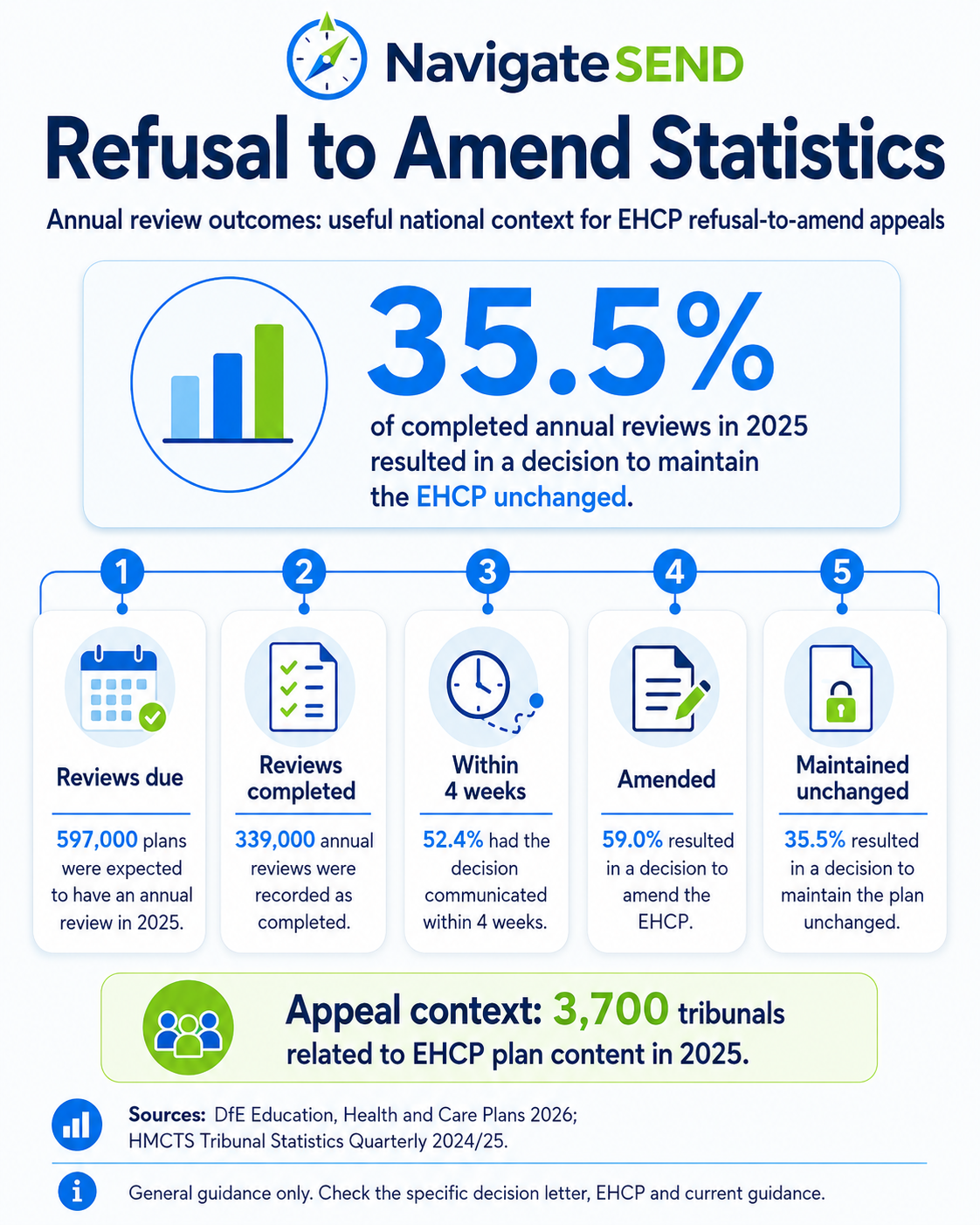
This timeframe matters because many families experience delay. Recent national data has shown that fewer than half of new EHC plans were issued within the 20-week timeframe in 2024. National reports and media coverage have also highlighted a system under pressure, with families worried about delays, access to support and proposed SEND reforms.
That wider context does not mean families should give up. It means the request should be as clear and organised as possible from the start.
The full assessment process and timeframes are set out in the SEND Code of Practice: 0 to 25 years.
How to make the request clearer and less overwhelming
Families often start the process when they are already tired. There may have been repeated meetings, worsening anxiety, school refusal, part-time timetables, exclusions, difficult transitions, or disagreement about what the child or young person needs.
A good starting point is to separate the information into five simple areas:
1. Strengths
What does the child or young person enjoy? What helps them engage? What are they good at? What motivates them?
2. Needs
What is difficult? Consider learning, communication, sensory needs, physical access, attention, emotional regulation, social interaction, anxiety, independence, health needs and fatigue.
3. Impact
How do those needs affect education? Are they falling behind, avoiding school, masking distress, becoming exhausted, unable to complete work, or needing high levels of adult support?
4. Support already tried
What has the setting done so far? What worked? What did not work? What only worked when a lot of adult support was available?
5. What may be needed next
What does the family, school, college or professional network think may be required? This might include specialist teaching, therapy input, assistive technology, environmental changes, a different curriculum, transition planning or more coordinated support.
This structure helps prevent the request from becoming either too emotional or too technical. It keeps the focus on the child or young person’s actual experience.
At Navigate SEND, we often describe this as turning concern into a coherent picture. Families do not need to sound like lawyers. They need to show, clearly and calmly, why the current support may not be enough and why an EHC needs assessment should be considered.
Questions families often ask
Is it called an EHCP needs assessment or an EHC needs assessment?
Families often call it an EHCP needs assessment because they are hoping it may lead to an EHCP. The formal term is EHC needs assessment, which means an assessment of education, health and care needs.
Do I need a diagnosis before requesting an EHC needs assessment?
Not always. A diagnosis can be helpful, but the key issue is the child or young person’s needs and the provision they may require. Evidence of impact, progress, support already tried and remaining barriers can be just as important.
Can a parent request an EHC needs assessment without the school?
Yes. A parent can request an EHC needs assessment directly from the local authority. It is usually helpful to include school or college evidence where possible, but families do not have to wait for the setting to make the request.
What happens if the local authority refuses to assess?
If the local authority refuses to assess, it should explain its reasons and provide information about next steps. Families may need to consider mediation, further evidence or appeal routes depending on the situation.
Does an EHC needs assessment always lead to an EHCP?
No. The assessment is used to decide whether an EHCP is necessary. The local authority may assess and then decide not to issue a plan, or it may decide that an EHCP is needed and issue a draft plan.
Next step
If you are thinking about requesting an EHC needs assessment, Navigate SEND can help you organise the evidence, clarify the main concerns and identify the strongest next step.