Are disability discrimination claims in schools increasing?

Matt Bell
Disability discrimination claims in schools appear to be increasing, although they remain a much smaller category than EHCP appeals. Families are increasingly asking whether what has happened is simply poor SEND support, a failure to deliver an Education, Health and Care Plan (EHCP), or possible disability discrimination under the Equality Act 2010.
This guide explains what the latest figures show, why claims may be increasing, what disability discrimination claims can and cannot do, and how Navigate SEND helps families work out the right route.
The short answer
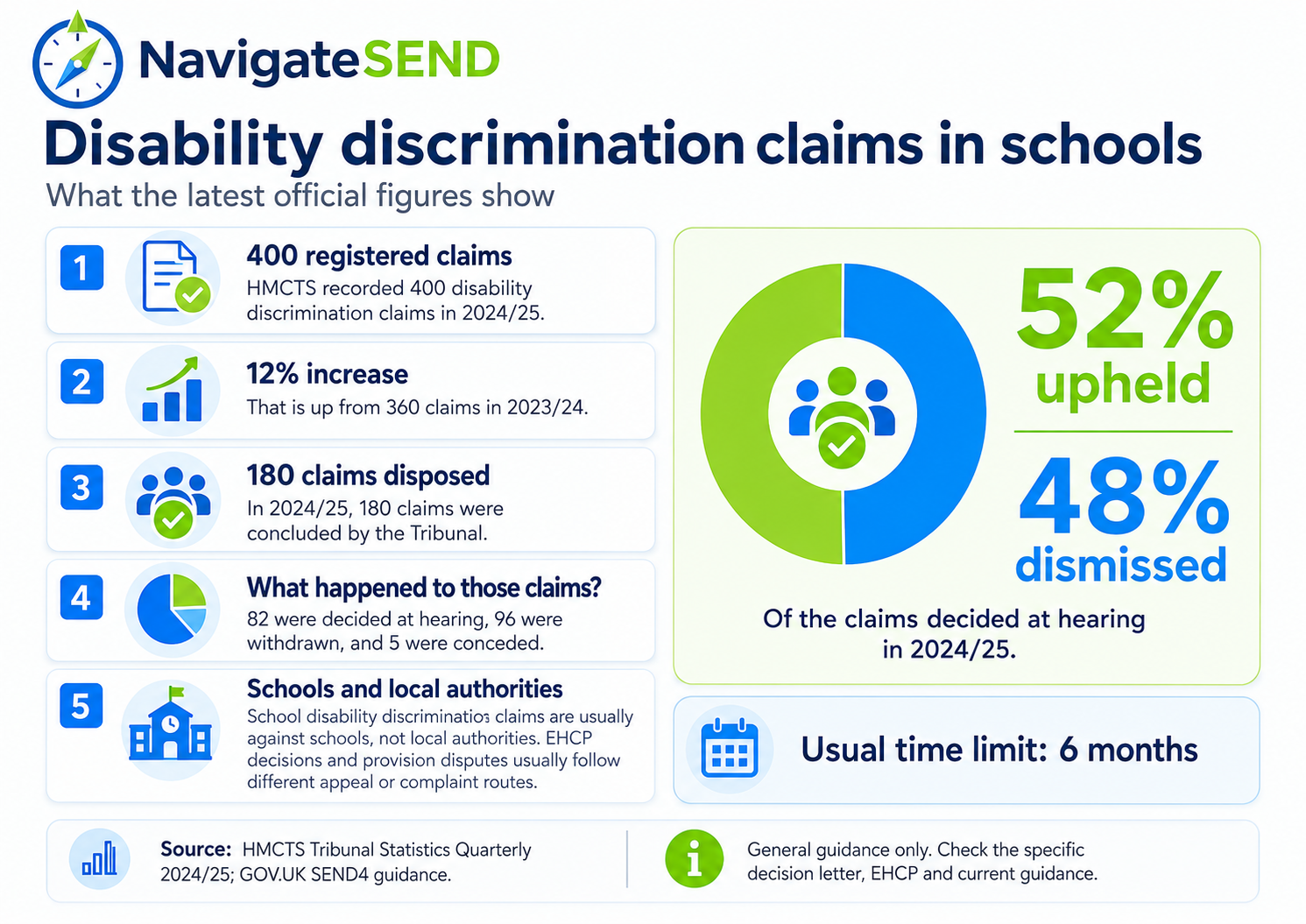
Yes, the latest official data shows that disability discrimination claims in schools are going up. In 2024/25, HMCTS recorded 400 registered disability discrimination appeals, which was 40 more than the previous year, a 12% increase. SEND Tribunals disposed of 180 disability discrimination claims in 2024/25, with 82 decided at hearing, 96 withdrawn before hearing, and 5 conceded. Of those decided at hearing, 52% were upheld and 48% were dismissed. (gov.uk)
That means claims are increasing, but the outcome pattern is very different from EHCP appeals. In the same year, 99% of decided SEN appeals were in favour of appellants overall, whereas disability discrimination claims were much closer to an even split when they reached a hearing.
What is a disability discrimination claim in school?
A disability discrimination claim is a claim that a school has unlawfully discriminated against a disabled pupil or prospective pupil under the Equality Act 2010.
These claims are heard by the First-tier Tribunal Health, Education and Social Care Chamber, Special Educational Needs and Disability jurisdiction. GOV.UK says claims can be brought against registered schools in England, including local authority maintained schools, academies, free schools, alternative provision academies and independent schools. (gov.uk)
Common claims include:
- unfavourable treatment because of something arising from disability;
- failure to make reasonable adjustments;
- exclusion or suspension linked to disability;
- refusal to adapt a behaviour, attendance, uniform or homework policy;
- exclusion from trips, clubs, lessons or school activities;
- lack of auxiliary aids or support;
- harassment or victimisation linked to disability.
The Judiciary says the Tribunal often has to decide whether the pupil has a disability and, if so, whether the school’s actions were reasonable and proportionate. It also says parties should focus on evidence of disability, specific incidents of discrimination and the reasons for the school’s actions. (judiciary.uk)
What do the latest numbers tell us?
The 2024/25 figures show three important things.
First, disability discrimination claims are rising. The latest HMCTS annual SEND statistics recorded 400 registered disability discrimination claims, up from 360 the previous year. That is a 12% increase.
Second, many claims do not reach a final hearing. Of the 180 disability discrimination claims disposed of in 2024/25, 96 were withdrawn before hearing and 5 were conceded. This does not necessarily mean families were wrong to bring them. Some may have settled, some may have achieved a practical resolution, and some may have found the process too difficult to continue.
Third, success rates are not as one-sided as EHCP appeals. Of the claims that were decided at hearing, 52% were upheld and 48% dismissed in 2024/25. In 2023/24, the split was 63% upheld and 37% dismissed.
So the answer is nuanced. Disability discrimination claims are increasing, but they are not automatic wins. They need careful preparation, clear facts and a strong link between disability, disadvantage and the school’s action or failure to act.
Why might disability discrimination claims be increasing?
The official statistics do not prove exactly why claims are increasing, but several pressures are likely contributing.
First, the wider SEND system is under strain. The National Audit Office reported that around 1.9 million children and young people aged 0 to 25 in England were identified as having SEN in January 2024, with 1.7 million at school. (nao.org.uk) The Public Accounts Committee described the SEN system as reaching, or arguably already at, crisis point, with high needs funding up 58% over a decade but EHCP numbers up 140%. (parliament.uk)
Second, mainstream schools are being asked to support more complex needs while families report that provision, staffing, training and specialist input are not always in place. Where support is missing, families may experience the issue as discrimination: a child is sanctioned for behaviour linked to disability, denied access to a trip, placed on a reduced timetable, or expected to follow a policy that does not work for them.
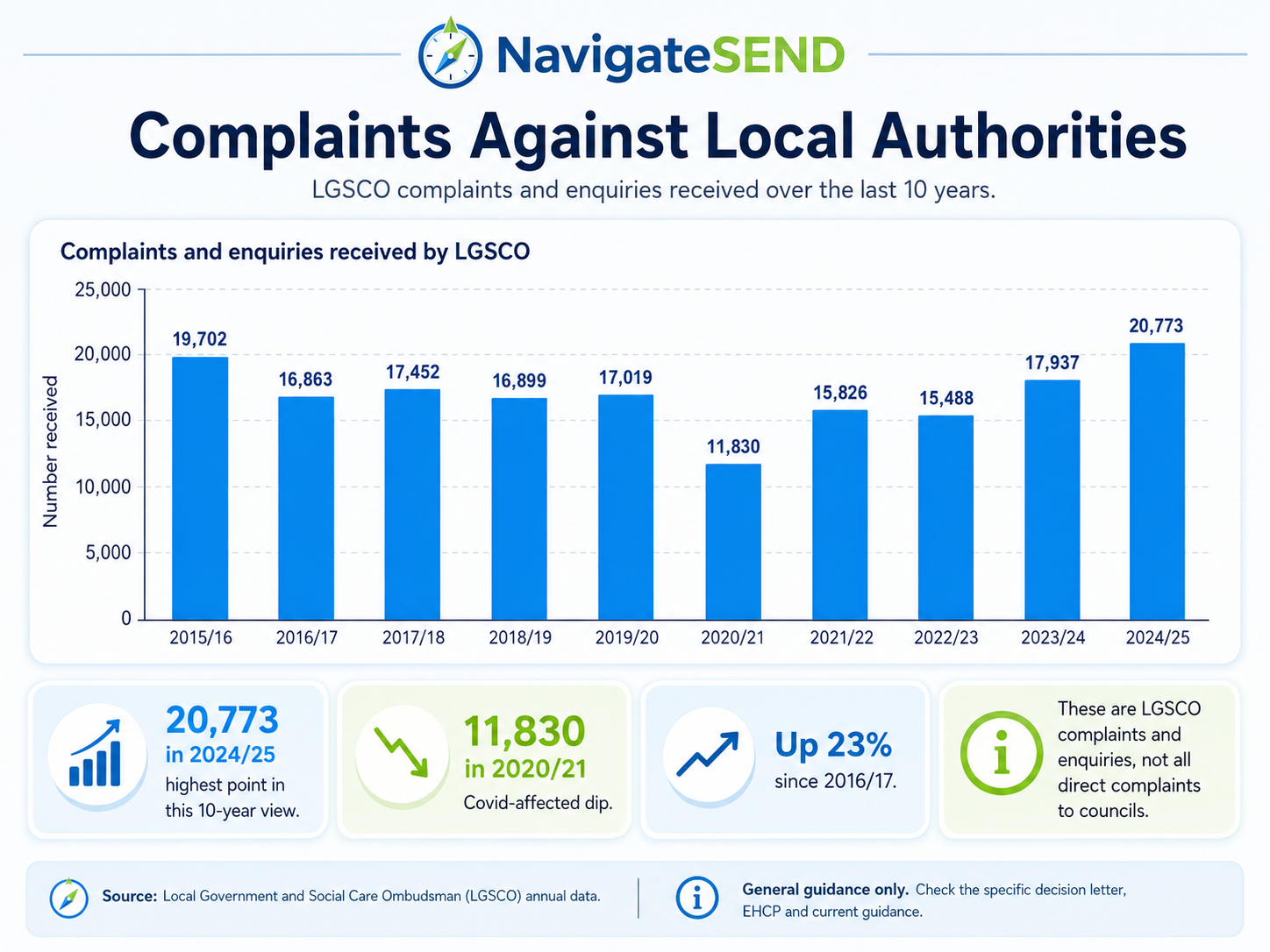
Third, complaints across SEND are rising. The Local Government and Social Care Ombudsman reported a record number of complaints and enquiries in 2024/25, exceeding 20,000 for the first time. (lgo.org.uk) Media coverage of Ombudsman data also reported that upheld SEND complaints rose from 258 in 2021 to 1,043 in 2024. Although Ombudsman complaints are not the same as Equality Act claims, they show the wider level of family dissatisfaction and service failure.
Fourth, awareness of reasonable adjustments is increasing. GOV.UK’s Education Hub explains that reasonable adjustments are intended to minimise disadvantages disabled pupils may face compared with peers, and that schools must not discriminate because of something that is a consequence of disability. More families now recognise that the issue may not only be SEND provision, but also whether the school changed its systems to reduce disadvantage.
What can disability discrimination claims cover?
A claim might be relevant where a disabled pupil has been treated unfairly because of disability, because of something connected to disability, or because reasonable adjustments were not made. (gov.uk)
Examples include:
- a pupil with autism being suspended for disability-related distress without proper adjustment;
- a pupil with ADHD being punished repeatedly for behaviour linked to regulation needs;
- a pupil with sensory needs being refused adjustments to uniform;
- a pupil with anxiety being treated as wilfully absent without considering disability;
- a pupil with physical needs being excluded from activities because planning was not done;
- a pupil with dyslexia not being given agreed auxiliary aids;
- a school refusing to adapt a behaviour policy where disability creates disadvantage.
GOV.UK’s SEND4 guidance says most claims the Tribunal sees are about unfavourable treatment or a school not making reasonable adjustments. It also explains that direct discrimination and indirect discrimination claims exist, but are harder to prove because the legal tests are strict.
What disability discrimination claims cannot do
This is just as important.
A disability discrimination claim is not the same as an EHCP appeal. It cannot be used to challenge a local authority decision about an EHC needs assessment or EHCP. GOV.UK is clear that disability discrimination claims cannot be made about local authority decisions on EHC needs assessments and EHC plans.
The Tribunal also cannot hear disability discrimination claims against local authorities, universities, further education colleges, 16 to 19 academies, nurseries or early years providers that are not part of a school or maintained by the local authority.
The Judiciary also warns that disability discrimination claims cannot be used to ask the Tribunal to decide whether a school has made the special educational provision in an EHCP. If the issue is that Section F provision in an EHCP is not being delivered, the route may be complaint, enforcement or local authority escalation, not a disability discrimination claim. (lgo.org.uk)
A successful claim also does not lead to financial compensation. GOV.UK says the Tribunal can order a reasonable solution but cannot order financial compensation. Possible remedies include staff training, new guidance, policy changes, extra tuition, a written apology, missed opportunities, or reinstatement after permanent exclusion.
How does exclusion fit in?
Exclusion and suspension are often where Equality Act issues become most visible.
A school can suspend or permanently exclude a disabled pupil, but it must still consider disability, reasonable adjustments and proportionality. GOV.UK’s SEND4 guidance gives the example of a pupil acting badly in class because they cannot control emotions due to autism or ADHD, and says the Tribunal will consider whether the exclusion or suspension was appropriate to achieve a legitimate aim such as safety and a calm learning environment.
This area has changed significantly since older training materials. The Upper Tribunal decision in C & C v The Governing Body of a School held that, in the education context, the Equality Act regulation excluding a “tendency to physical abuse” from the definition of impairment could not be applied in the same way to children whose recognised condition was more likely to result in that behaviour.
The practical point is not that schools can never exclude. It is that they should not treat disability-related behaviour as a purely disciplinary issue without considering support, reasonable adjustments, de-escalation, unmet needs and whether the response was proportionate.
What should families do before making a claim?
Families should first identify the route. Is this:
- a disability discrimination claim against a school?
- an EHCP appeal against the local authority?
- a complaint about provision not being delivered?
- an exclusion review or Independent Review Panel issue?
- an Ombudsman complaint?
- a school complaints process issue?
Then organise the facts.
A useful structure is:
- What happened?
- When did it happen?
- What disability does the child or young person have?
- What did the school know, or what should it have known?
- What disadvantage did the child experience?
- What adjustment was requested or should have been considered?
- What was the impact?
- What outcome is being requested?
Time limits are critical. GOV.UK says claims must usually be received by the Tribunal within six months of the conduct being complained about. (gov.uk) Where the complaint is about a failure to do something, the time limit may run from when the school decided not to act, or when it could reasonably have been expected to decide.
Families should avoid trying to include every frustration. A strong claim is usually focused, factual and structured around the relevant legal tests.
How Navigate SEND supports families with disability discrimination concerns
Navigate SEND helps families work out whether the issue is disability discrimination, unmet SEND, EHCP wording, provision not being delivered, exclusion, attendance, or a mixture of routes.
We can help by:
- reviewing what happened and identifying the correct route;
- separating school discrimination issues from local authority EHCP issues;
- organising a timeline of incidents;
- identifying possible reasonable adjustments;
- reviewing whether disability and school knowledge can be evidenced;
- helping families decide whether to complain, mediate, appeal or claim;
- preparing for school meetings or reintegration discussions;
- reviewing EHCP sections where missing provision may be contributing to discrimination risk;
- supporting wider SEND strategy where exclusion, reduced timetable or placement breakdown is involved.
The aim is not to push every case into Tribunal. Disability discrimination claims can be stressful and adversarial. The priority is to choose the route most likely to protect the child or young person’s access to education.
Questions families often ask
Are disability discrimination claims in schools increasing?
Yes. HMCTS recorded 400 registered disability discrimination claims in 2024/25, up 12% from the previous year. The increase is real, although the number remains far smaller than SEN appeals about EHCPs.
Is disability discrimination the same as poor SEND support?
Not always. Poor SEND support may be a school issue, an EHCP issue, or a local authority issue. Disability discrimination is more specific: it concerns unlawful treatment, disadvantage or failure to make reasonable adjustments under the Equality Act 2010.
Can I claim against the local authority for disability discrimination in the SEND Tribunal?
Usually no. School disability discrimination claims are made against the responsible body of the school, not the local authority. Local authority EHCP decisions usually need to be challenged through SEND appeal, complaint or another route.
Can the Tribunal award compensation?
No. The Tribunal can order practical remedies such as training, policy changes, apologies, extra tuition or reinstatement after permanent exclusion, but it cannot award financial compensation.
Can Navigate SEND help work out whether to claim?
Yes. Navigate SEND can help review the facts, identify the right legal or practical route, organise evidence and prepare for discussions, complaints, EHCP action or Tribunal where appropriate.
Next step
If you are unsure whether your child’s situation is disability discrimination, unmet SEND support or an EHCP issue, Navigate SEND can help you map the problem, organise the evidence and identify the strongest next step.