What do SEND tribunal procedures actually cover?

Matt Bell
SEND tribunal procedures can feel overwhelming when a family is already trying to secure support, provision or a suitable school placement for a child or young person. The process can look formal, slow and intimidating, especially when families feel the local authority is using the appeal system to delay making provision.
This guide explains what the SEND Tribunal is for, what it is not responsible for, what families can ask for, how the process usually works, and how Navigate SEND supports families and professionals through the decision-making route.
The short answer
SEND tribunal procedures exist to decide specific appeals about Education, Health and Care needs assessments and Education, Health and Care Plans (EHCPs). The Tribunal can consider issues such as refusal to assess, refusal to issue an EHCP, the wording of Sections B and F, school or college placement in Section I, refusal to amend, reassessment and ceasing a plan.
The Tribunal is not a general complaints body. It does not normally investigate poor communication, compensate families for distress, supervise day-to-day provision, punish local authorities for delay, or resolve every education, health or social care issue. It can make binding decisions about education matters, and in some appeals it can make non-binding recommendations about health and social care.
Why SEND tribunal procedures are in the spotlight
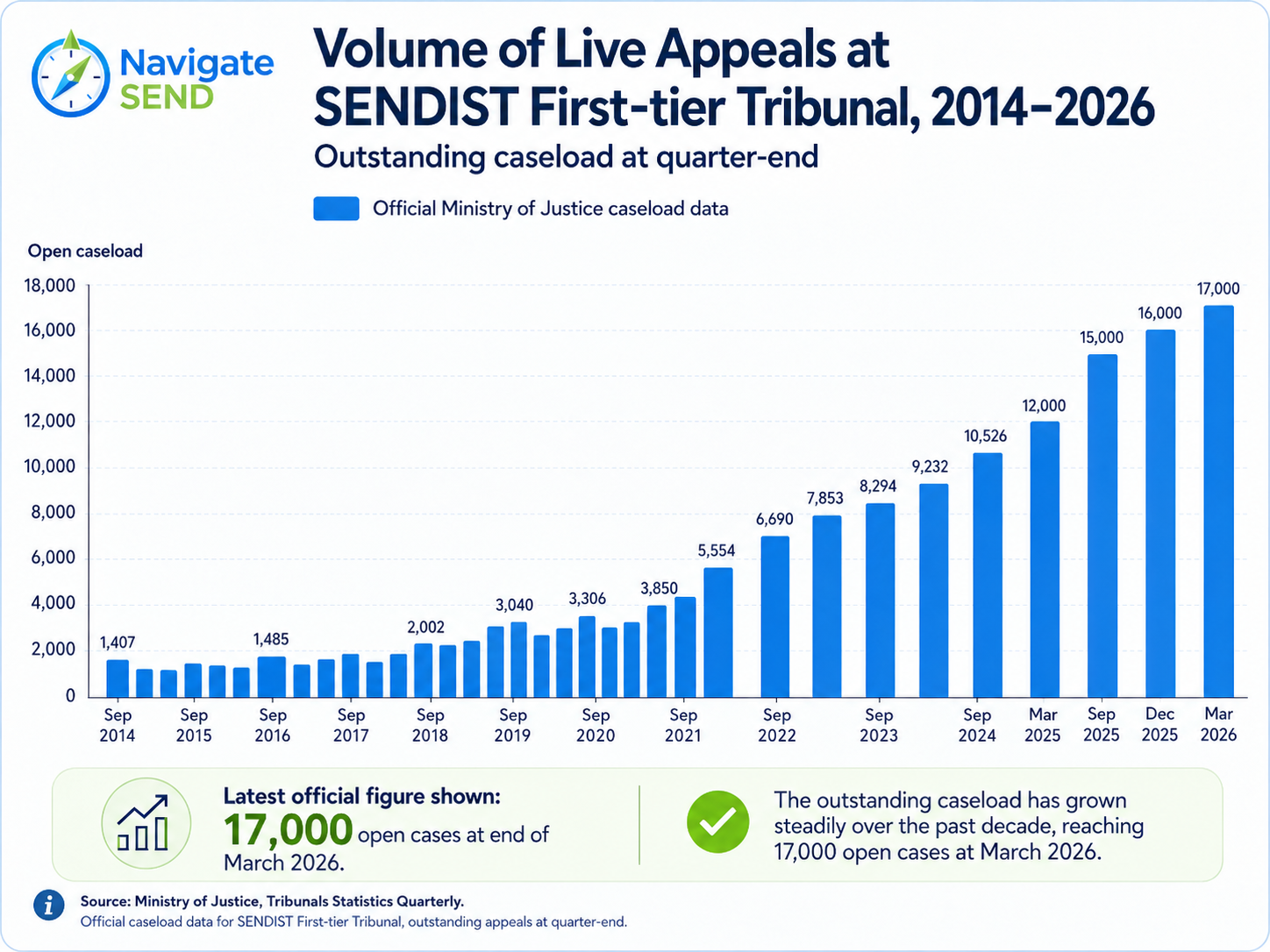
SEND tribunal procedures are receiving more public attention because more families are having to appeal.
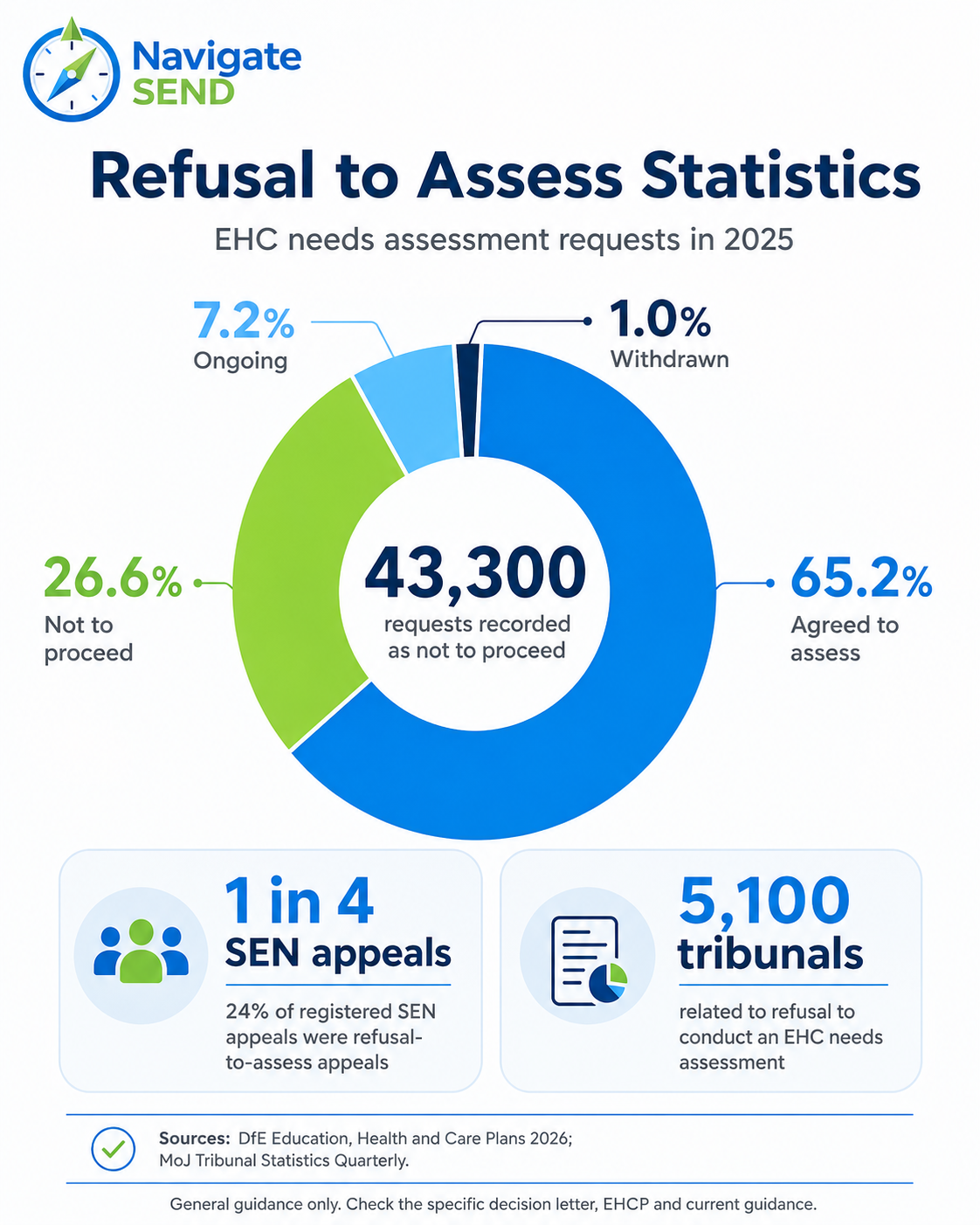
HMCTS recorded 25,000 registered SEN appeals in the 2024/25 academic year, an 18% increase on the previous year. (gov.uk) Of those appeals, 24% related to refusal to secure an EHC needs assessment, while 61% related to the content of EHC plans. HMCTS also recorded that 99% of cases decided by the Tribunal were in favour of the appellant, where the appellant won the majority of the appeal.
This matters because it shows two things at once. First, families are using the Tribunal more often. Second, many appeals succeed, which raises serious questions about the quality of local authority decision-making before families are forced into the appeal process.
Recent media reporting has also described families waiting more than a year for hearings, with councils sometimes conceding shortly before the hearing or failing to implement findings promptly. The Guardian reported that parents had been “trapped” in a growing SEND Tribunal backlog, with new cases rising sharply and delays causing disadvantage for children who were waiting for suitable education and provision.
The National Audit Office has described the SEND system as under significant pressure and not delivering better outcomes despite increased high-needs funding. (nao.org.uk) The Public Accounts Committee has also said the SEN system is inconsistent, inequitable and not delivering in line with expectations, undermining parental confidence. (parliament.uk)
For families, the practical concern is simple: if the Tribunal takes months, what happens to the child in the meantime?
What can the SEND Tribunal decide?
The SEND Tribunal is part of the First-tier Tribunal. GOV.UK explains that families and young people can appeal to the Tribunal if they disagree with a local authority decision about a child or young person’s EHC needs or plan. (gov.uk) The appealable decisions include refusal to carry out an EHC needs assessment or reassessment, refusal to issue an EHCP, refusal to change education sections of an existing EHCP, or a decision that the child or young person no longer needs an EHCP.
In practice, common Tribunal appeals include:
- refusal to carry out an EHC needs assessment;
- refusal to issue an EHCP after assessment;
- refusal to reassess;
- refusal to amend an EHCP after review or reassessment;
- disagreement with Section B, which describes special educational needs;
- disagreement with Section F, which specifies special educational provision;
- disagreement with Section I, which names the school, college or type of setting;
- decision to cease to maintain an EHCP.
The Tribunal can make binding decisions on education matters. For example, it can order the local authority to carry out an assessment, issue and maintain an EHCP, amend the plan, change the named school or college, continue a plan, or reconsider a decision. The SEND Code of Practice explains that the Tribunal has prescribed powers and that local authorities have time limits for complying with Tribunal decisions. (gov.uk)
What is the Tribunal not responsible for?
This is where much confusion arises.
The SEND Tribunal is not responsible for every problem within SEND. It is not a general complaints service, and it is not the body that investigates all delay, maladministration or poor service.
The Tribunal usually does not deal with:
- general complaints about local authority behaviour;
- compensation for distress, time or inconvenience;
- day-to-day school complaints;
- transport appeals as a standalone issue;
- failure to deliver EHCP provision where the wording is already clear;
- delay in completing annual reviews, unless it leads to an appealable decision;
- failure to issue decision letters;
- complaints about social care process alone;
- complaints about NHS service failures alone;
- disciplinary matters or exclusions, unless there is a separate disability discrimination claim or relevant appeal route.
That does not mean those problems do not matter. It means they may need a different route.
For example, if Section F clearly says a child should receive weekly speech and language therapy and it is not happening, the issue may be enforcement or complaint rather than a Tribunal appeal about the contents of the plan. The Local Government and Social Care Ombudsman can investigate some SEND complaints, including delay, failure to carry out annual reviews and failure to ensure EHCP provision is delivered. (lgo.org.uk)
If the issue is the wording of Section F because the plan is too vague, the Tribunal may be the right route. If the issue is that the provision is clear but not being delivered, complaint, pre-action correspondence or judicial review may need to be considered.
How do health and social care issues fit in?
The Tribunal’s main binding powers are about education. However, the Tribunal’s extended powers mean families and young people can ask for non-binding recommendations about health and social care needs or provision in many EHCP appeals, provided there is also a valid education appeal.
GOV.UK explains that the extended powers, first tested through the National Trial, were continued from July 2021. (gov.uk) They allow the Tribunal to make non-binding recommendations about health and social care aspects of EHCPs where the appeal also includes education elements.
This can be useful where the plan has weak Sections C, D, G, H1 or H2, or where education, health and care are closely connected. However, families should understand the limitation: health and social care recommendations are not the same as binding education orders.
If a health or social care body does not follow a recommendation, it should give reasons. The next route may involve complaint to the relevant health body, the Parliamentary and Health Service Ombudsman, the Local Government and Social Care Ombudsman, or legal advice.
How do SEND tribunal procedures usually work?
SEND tribunal procedures usually begin with the local authority decision letter. That letter should explain the decision, appeal rights and mediation information.
In many appeals, families must contact a mediation adviser and obtain a mediation certificate before registering the appeal. Placement-only appeals about Section I are treated differently and may not require a mediation certificate.
The usual appeal deadline is two months from the local authority’s decision letter or one month from the mediation certificate, whichever is later. GOV.UK’s appeal guidance confirms that in most cases families must speak to a mediation adviser before appeal.
The appeal is usually made using the current GOV.UK Tribunal form. Form SEND35 is used for many EHCP appeals, and SEND35A is used for appeals against refusal to secure an EHC needs assessment. (gov.uk) GOV.UK updated the SEND35 form in February 2026 and the SEND35A page in March 2026. (gov.uk)
Once the appeal is registered, the Tribunal will issue directions. These usually set out deadlines for the local authority response, evidence, attendance information, working documents and bundle preparation. If a party does not comply with directions, the Tribunal can make further directions or, in more serious cases, restrict participation or strike out parts of a case. (gov.uk)
The uploaded Tribunal procedure module explains the importance of the Tribunal’s overriding objective: dealing with cases fairly and justly, avoiding unnecessary formality, enabling participation, using specialist expertise effectively, and avoiding delay where compatible with proper consideration of the issues.
What can families ask for during the Tribunal process?
Families can ask the Tribunal to decide the appeal itself, but they can also ask for case-management directions during the process.
Depending on the case, families may ask for:
- the local authority to disclose missing documents;
- clarification of the local authority’s position;
- an updated electronic working document;
- further assessment or advice;
- permission to rely on additional evidence;
- a witness summons where a witness is reluctant or unable to attend voluntarily;
- additional witnesses where needed;
- changes to deadlines;
- the appeal to include health or social care recommendations;
- a case-management hearing where the issues are complex.
In appeals about EHCP contents, the working document is often central. It shows the wording of the current EHCP and the amendments requested by the family or young person. This is usually where Sections B, F and I become clearer.
Families should avoid simply saying, “The plan is wrong.” It is usually more effective to say exactly what should change and why.
Are local authorities using Tribunal procedure to delay provision?
Some families strongly feel that they are. The evidence does not allow every local authority motive to be proven in every case, but the public concern is real.
The Guardian reported that the Tribunal Procedure Committee had implied councils may be dragging out tribunals to save money by not meeting needs during the appeal period. It also reported cases where councils conceded late or failed to implement findings promptly.
The Administrative Justice Council’s 2024 report on improving local authority SEND decision-making found that registered appeals had increased every year since 2011, except 2014–15, and that the appeal success rate had risen from 68.5% in 2011 to 96.3% in 2022. The report recommended better decision-making tools, learning from Tribunal outcomes and improved training for local authority decision-makers.
The Ombudsman has also found fault where local authority actions delayed appeal rights. In one case, the Ombudsman found the council delayed issuing an EHCP decision, delayed appeal rights, cancelled mediation and wrongly conflated two separate EHCP processes.
Families cannot always prove that delay is deliberate. But they can protect themselves by tracking dates, asking for decisions in writing, registering appeals on time, preparing evidence early and using complaint or legal routes where delay itself is the problem.
What happens after a Tribunal decision?
Once the Tribunal issues a decision, the local authority must comply within the relevant legal timescale. The SEND Regulations 2014 contain the compliance rules. Regulation 44 deals with compliance with Tribunal orders, while Regulation 45 deals with unopposed appeals.
In practical terms, the required next step depends on what the Tribunal ordered. For example, the local authority may have to start an assessment, issue a draft plan, amend an EHCP, name a school or continue maintaining the plan.
Families should not assume implementation will happen automatically. They should diarise the deadline and ask the local authority to confirm the timetable for compliance.
If the local authority does not comply, the next route may be complaint, escalation, formal legal correspondence or judicial review. The Tribunal has made the decision, but it does not usually supervise everyday delivery after the order.
How Navigate SEND supports SEND Tribunal procedures
Navigate SEND helps families and professionals decide whether Tribunal is the right route and prepare the case clearly.
We can help by:
- identifying the exact decision being appealed;
- checking whether the issue belongs in Tribunal, complaint, annual review, amendment or another route;
- tracking mediation certificate and appeal deadlines;
- organising evidence and professional reports;
- reviewing Sections B, F and I;
- preparing proposed wording for a working document;
- clarifying placement arguments;
- helping families understand health and social care recommendation options;
- preparing questions for case-management directions;
- supporting families where local authority delay is affecting provision;
- helping families decide what outcome they are asking the Tribunal to order.
The aim is not to make the process more adversarial. It is to make it clearer, more focused and less overwhelming. For families juggling more than one SEND issue at once, this can extend into ongoing strategic advisory support.
Questions families often ask
What is the SEND Tribunal for?
The SEND Tribunal decides specific appeals about local authority decisions on EHC needs assessments and EHCPs. It can make binding decisions about education sections and placement, and in some cases non-binding recommendations about health and social care.
Can the SEND Tribunal make a local authority pay compensation?
Usually no. The Tribunal is not normally a compensation body. Complaints about distress, delay, poor communication or maladministration may need to go through the Local Government and Social Care Ombudsman or another route.
Can I appeal if the local authority refuses to assess?
Yes. Refusal to carry out an EHC needs assessment is an appealable decision. The current GOV.UK form for that appeal is SEND35A.
Can the Tribunal deal with health and social care?
Only in a limited way. If there is a valid education appeal, the Tribunal can make non-binding recommendations about health and social care needs and provision in the EHCP.
Can Navigate SEND help with Tribunal preparation?
Yes. Navigate SEND can help clarify the appeal issue, organise evidence, review EHCP wording, prepare proposed amendments and identify whether Tribunal or another route is the strongest next step.
Next step
If you are unsure whether SEND tribunal procedures are the right route for your case, Navigate SEND can help you understand the decision, protect deadlines and prepare a clear, evidence-led next step.
Internal link suggestion: Link this CTA to the most relevant Navigate SEND service page, such as “Challenging SEND Decisions: Mediation and Appeals”, “EHCP Amendments”, “EHCP Provision Not Being Delivered” or “Ongoing SEND Strategic Advisory”.