How to appeal a SEND refusal to assess decision

Matt Bell
A SEND refusal to assess appeal is often the first formal challenge a family faces when they are trying to secure help through an Education, Health and Care needs assessment. It can feel especially frustrating when a child or young person is already struggling, but the local authority says the school or college should continue through ordinary SEN Support.
This guide explains what is happening nationally, why there are so many refusal-to-assess appeals, what the actual legal test is, what the Tribunal can and cannot decide, and how Navigate SEND helps families prepare a clear, evidence-led next step. Every child and young person has a right to an appropriate education, and a refusal to assess can feel like a barrier to that right.
The short answer
A SEND refusal to assess appeal challenges a local authority decision not to carry out an Education, Health and Care needs assessment. The legal test is deliberately low: the child or young person must have or may have special educational needs, and it may be necessary for special educational provision to be made through an EHCP.
Families do not have to prove that an EHCP is definitely needed. The assessment is the process used to find that out. Tribunal statistics do not publish a separate success rate for refusal-to-assess appeals, but overall SEND appeal outcomes are overwhelmingly in families’ favour, and refusal-to-assess cases are widely recognised as among the strongest appeal types where the evidence is organised.
Why are so many EHC needs assessment requests being refused?
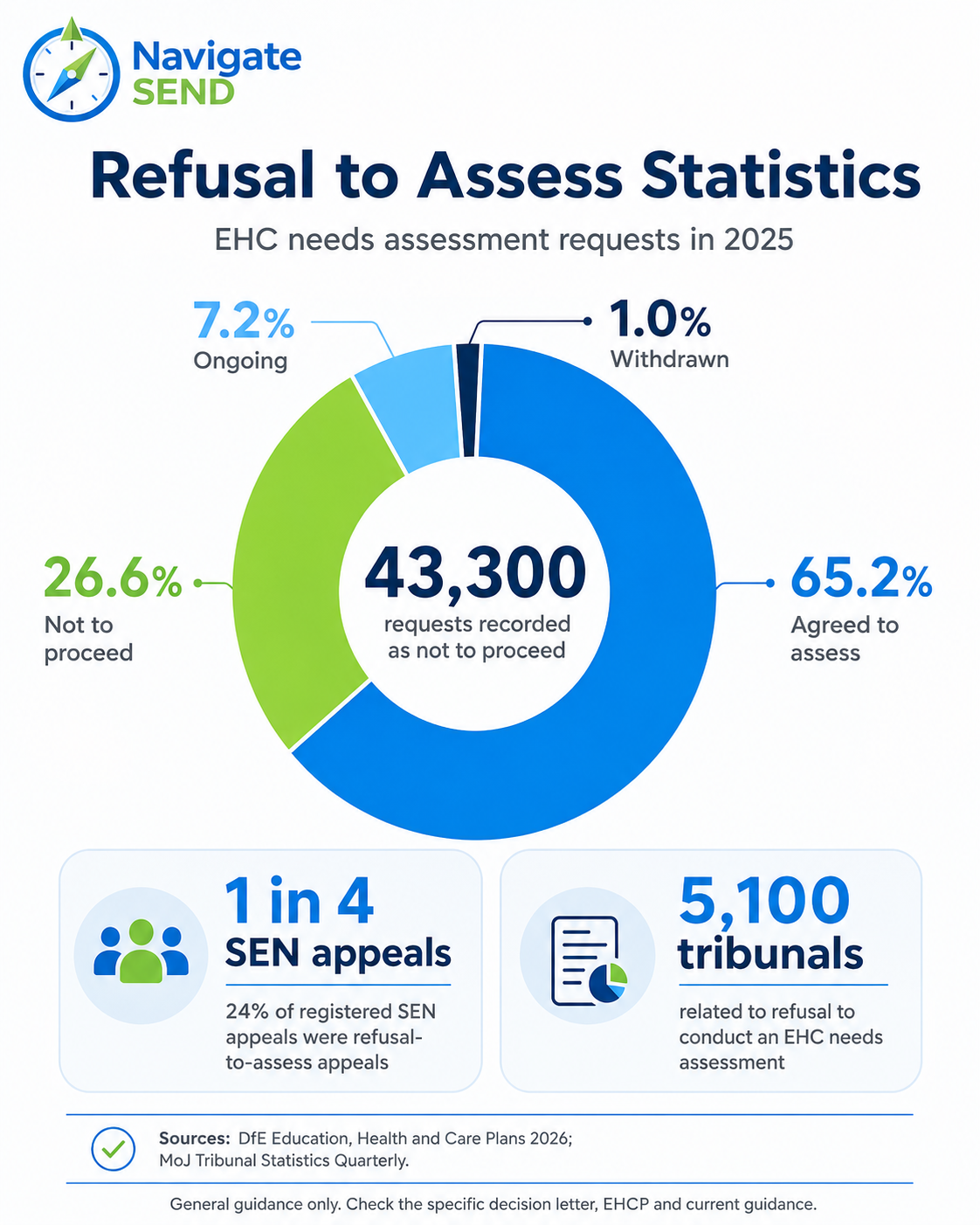
Requests for EHC needs assessments have risen sharply. Department for Education data shows that local authorities received 154,500 requests in 2024, which was 11.8% higher than in 2023. Local authorities agreed to assess in 65.4% of those requests. Put another way, around one in three requests did not proceed to assessment. (gov.uk)
There are several reasons behind this. More children and young people are presenting with complex profiles involving anxiety, autism, communication needs, learning differences, sensory needs, attendance difficulties and mental health barriers. Schools are reporting pressure on staffing, specialist support and budgets. (nao.org.uk) Local authorities are facing large high-needs deficits and rising demand for specialist placements. (parliament.uk)
Families also see the national policy context. Safety Valve and Delivering Better Value programmes were designed to help local authorities address high-needs deficits and make local SEND systems financially sustainable. (gov.uk) GOV.UK now says the Safety Valve programme closed on 1 April 2026 and was replaced by the High Needs Stability Grant (gov.uk), but the wider pressure remains: local SEND reform plans and financial sustainability are still central to the national agenda.
The 2026 SEND reform consultation also proposes a stronger mainstream inclusion system, new support layers and future changes to how EHCPs operate. GOV.UK says there will be no changes to support received through existing EHCPs before at least September 2030 (gov.uk), but families are understandably concerned that local decisions today may already be influenced by a desire to reduce statutory escalation.
What is the actual legal test for a refusal to assess appeal?
The legal test is in section 36(8) of the Children and Families Act 2014. The local authority must secure an EHC needs assessment if the child or young person has or may have special educational needs, and it may be necessary for special educational provision to be made in accordance with an EHCP.
This is a “may” test. It does not require certainty. Families do not have to prove that the child definitely needs an EHCP. They need to show that the child may have special educational needs and that it may be necessary for provision to be made through a plan.
The uploaded refusal-to-assess module makes this point strongly: the purpose of the assessment is to determine whether an EHCP is necessary, so a local authority should not refuse assessment simply because it has already decided a plan is unnecessary. It also explains that the bar is not high, and that a diagnosis is not required if the evidence shows a learning difficulty, disability or barrier affecting access to education.
For young people over 18, there is an additional consideration: the local authority must consider whether the young person requires additional time, compared with others of the same age without SEN, to complete education or training.
What arguments are not enough from a local authority?
Local authorities sometimes refuse assessment using reasons that sound official but do not match the legal test. These may include saying the school has not spent enough money, that the child is not far enough behind, that there is no diagnosis, that SEN Support has not been exhausted, or that the child does not meet local criteria.
The key point is that local policy cannot replace the law. A local authority may have internal thresholds or decision-making panels, but the Tribunal applies the statutory test. The uploaded module notes that there is no legal requirement for a school to have spent a particular amount, such as £6,000, before a local authority must assess.
Blanket policies are also a problem. A local authority should not refuse to assess all children with a particular diagnosis, all children in mainstream school, all children who are academically able, or all children who have not yet received a particular intervention. The question must be individual: what are this child or young person’s needs, what provision may be required, and might that provision need to be secured through an EHCP?
How many refusal-to-assess appeals do families win?
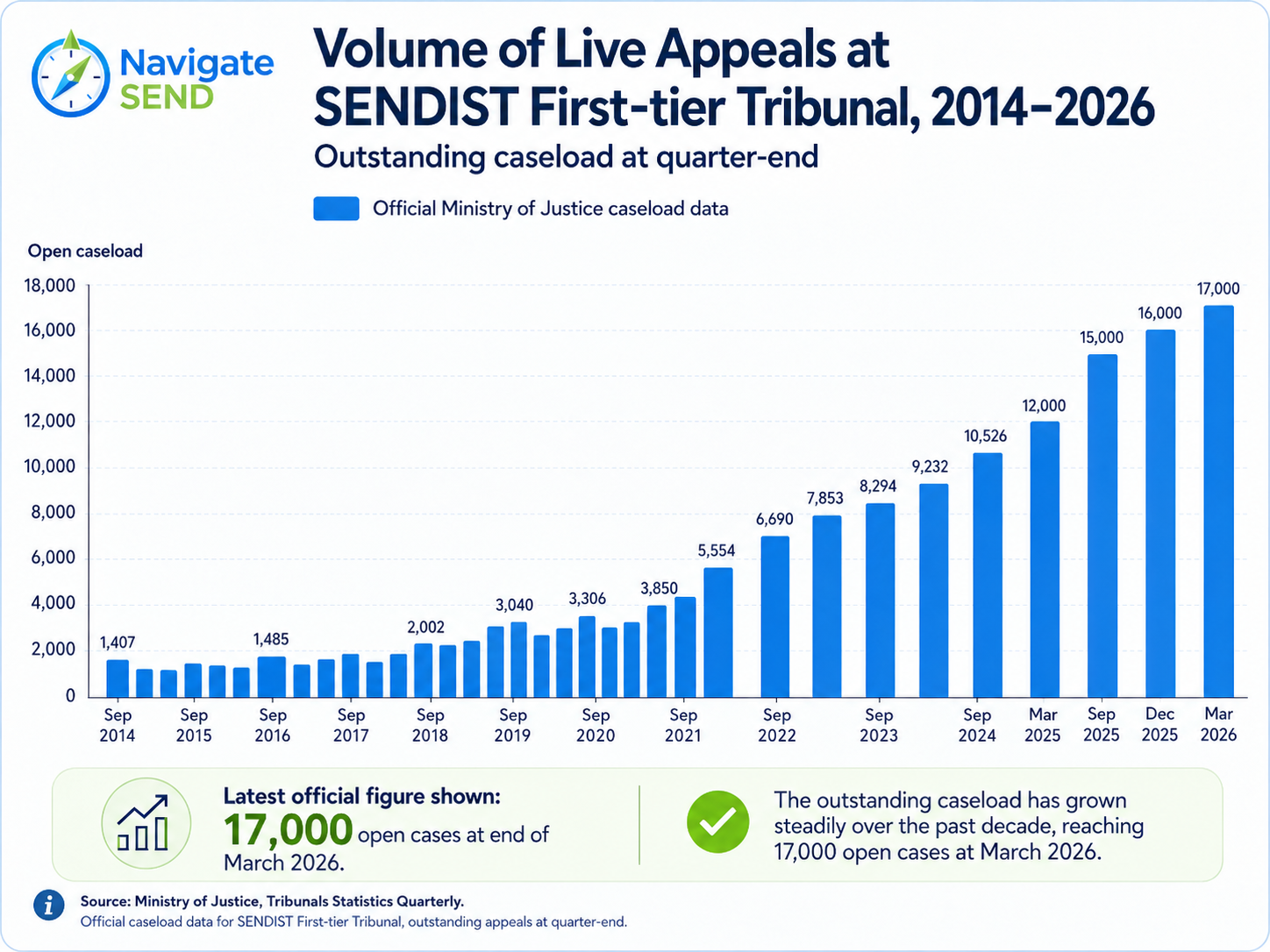
This is where the numbers need careful wording. HMCTS data for the 2024/25 academic year recorded 25,000 registered SEN appeals. (gov.uk) Around 24% were against refusal to secure an EHC assessment. That means refusal-to-assess appeals form a very significant part of the SEND Tribunal workload.
HMCTS also reported that 99% of cases decided by the Tribunal were in favour of the appellant. That figure is for decided SEND appeals overall, not a separate refusal-to-assess-only percentage. A 2024 judiciary report similarly says the published tribunal statistics do not give a detailed breakdown by appeal type, but notes that refusal-to-assess cases are among those most likely to be decided in favour of appellants. (judiciary.uk)
The practical message is clear: families should not assume a refusal is the end of the road. Many refusal-to-assess decisions are successfully challenged, especially where the family can show that ordinary support has not been enough, that the child’s needs are not fully understood, or that a full assessment is needed to identify provision.
What does a refusal-to-assess appeal actually decide?
A refusal-to-assess appeal decides whether the local authority should carry out an EHC needs assessment. It does not decide the final contents of an EHCP, the school placement, the amount of therapy, the number of support hours, or whether a final plan must definitely be issued.
This distinction matters. The assessment is the gateway. If the Tribunal orders the assessment, the local authority must assess and gather advice. After that, the authority must decide whether to issue an EHCP. If it refuses to issue, or issues a weak plan, further challenge may be needed.
Refusal-to-assess appeals are usually dealt with “on the papers”, meaning there is normally no oral hearing. The Tribunal considers the written appeal, local authority response and evidence. Families can request an oral hearing, but in many cases the written route is quicker and sufficient. For a full walkthrough of how the process works from registration to decision, see our guide to SEND Tribunal procedures.
What evidence helps in a refusal-to-assess appeal?
The strongest refusal-to-assess appeals are focused and evidence-led. Families should keep returning to the two-part legal test.
- Evidence that the child or young person has or may have SEN.
- Evidence that ordinary SEN Support may not be enough.
- Evidence that professionals do not yet fully understand the needs.
- Evidence that support has been tried but progress remains limited, uneven or dependent on unsustainable help.
- Evidence that a transition, placement change or post-16 move may require statutory coordination.
Useful documents may include school reports, SEN Support plans, assess-plan-do-review records, attendance data, behaviour or anxiety logs, professional reports, emails from school, examples of work, exclusion or suspension records, therapy advice, parent views and the child or young person’s own views.
School support is helpful but not essential. Some children mask at school, present differently at home, or attend a setting that does not recognise the scale of need. In those cases, families may need to use evidence from home, health professionals, independent reports or other people who know the child well.
How should families navigate the appeal process?
Start with the decision letter. Check the date, the reason for refusal and whether it explains mediation and appeal rights. In most refusal-to-assess cases, families need to contact a mediation adviser and obtain a mediation certificate before appealing.
The usual deadline is two months from the local authority decision letter or one month from the mediation certificate, whichever is later. (gov.uk) The current GOV.UK refusal-to-assess appeal form is SEND35A. (gov.uk) The form can be used by parents, people with parental responsibility, or a young person aged 16 to 24.
A practical route is:
- Record the appeal deadline immediately.
- Contact the mediation adviser and obtain the certificate if required.
- Read the refusal reasons carefully and identify where the local authority has applied the wrong test or missed evidence.
- Prepare short, clear grounds of appeal using the section 36(8) test.
- Attach focused evidence rather than every document ever created.
- Ask the Tribunal to order the local authority to carry out an EHC needs assessment.
If the local authority concedes, families should ask for written confirmation and track the follow-on timetable. If the Tribunal orders an assessment, the local authority must act within the regulatory timescales and move the assessment process forward. Where a local authority fails to comply, this can also be raised with the Local Government and Social Care Ombudsman (lgo.org.uk).
How Navigate SEND supports refusal-to-assess appeals
Navigate SEND helps families and professionals turn a refusal into a clearer, evidence-led next step.
We can help by reviewing the refusal letter, identifying the legal test, organising the evidence, clarifying whether the appeal is strong, preparing a concise appeal structure, checking deadlines, helping families decide whether mediation is useful, and planning what happens after the appeal. For families juggling more than one SEND issue at once, this can extend into ongoing strategic advisory support.
We also help families avoid two common problems. The first is overcomplicating the appeal with everything that has gone wrong. The second is underexplaining why assessment may be necessary. A strong refusal-to-assess appeal is usually simple: here are the needs, here is the support tried, here is why assessment may be necessary, and here is the evidence.
If the appeal succeeds, Navigate SEND can also help families prepare for the assessment stage, request appropriate professional advice, review draft plans, and make sure the case does not lose momentum after the assessment is ordered. Once a plan is issued, it is also worth checking that it properly specifies the provision your child needs — see our guide to the EHCP duty to specify.
Questions families often ask
Does a refusal to assess mean my child cannot get an EHCP?
No. It means the local authority has decided not to assess at this stage. You may be able to appeal that decision, and many families successfully challenge refusals to assess.
Do I need to prove my child definitely needs an EHCP?
No. For a refusal-to-assess appeal, the question is whether your child has or may have SEN and whether it may be necessary for provision to be made through an EHCP. The assessment is there to decide whether a plan is actually needed.
Is a diagnosis required before requesting an EHC needs assessment?
No. A diagnosis can help, but it is not required. The focus is on needs, barriers to learning, support required and whether special educational provision may need to be secured through a plan.
Will there be a Tribunal hearing?
Usually not. Refusal-to-assess appeals are normally considered on the papers. Families can request an oral hearing, but in many cases written evidence is enough.
Can Navigate SEND help with a SEND35A appeal?
Yes. Navigate SEND can help review the refusal, organise evidence, clarify the legal test, prepare the appeal structure and support the next stage if the local authority is ordered to assess.
Next step
If your local authority has refused to carry out an EHC needs assessment, Navigate SEND can help you understand the decision, protect the deadline and prepare a clear, evidence-led refusal-to-assess appeal.
Internal link suggestion: Link this CTA to “EHCP Needs Assessment Requests & Reassessments”, “Challenging SEND Decisions: Mediation and Appeals” or “Ongoing SEND Strategic Advisory”.