How personal budgets and direct payments work in health and social care

Matt Bell
Personal budgets and direct payments health and social care arrangements can give families more choice over how support is organised, but they are often poorly explained. Families may hear about direct payments for respite, community access, personal care, continuing care, equipment or therapy, without knowing what can actually be requested or which organisation is responsible.
This guide explains how personal budgets and direct payments work across health and social care, what families can ask for, how they connect with Education, Health and Care Plans (EHCPs), and how Navigate SEND helps families make sense of the options, alongside the wider right to education that all children and young people have.
The short answer
A personal budget is an identified amount of money linked to assessed needs and agreed outcomes. A direct payment is one way of receiving that budget, where money is paid to a parent, young person, adult, representative or nominee so they can arrange agreed support themselves.
In social care, personal budgets and direct payments usually follow an assessment by the local authority. In health, personal health budgets are NHS-funded and may be available for people with certain assessed health needs, including children and young people eligible for continuing care. (england.nhs.uk) These arrangements are not blank cheques: the money must be used to meet needs and outcomes agreed in a care plan, support plan, personalised care and support plan or EHCP.
Why families often do not know what can be requested
Families often think of personal budgets and direct payments only as “money for care hours”. They can be more flexible than that, but only when the support is linked to assessed need.
For disabled children and young people, the possible areas may include short breaks, respite, personal care, access to the community, support during school holidays, help with independence, personal assistants, equipment, travel linked to services, activities, social participation, communication support, some therapy or health-related support, and support that helps the family manage daily life.
The difficulty is that families are often given fragmented information. Health may talk about a personal health budget. Social care may talk about direct payments. SEND teams may talk about Section J of an EHCP. Adult services may talk about a Care Act personal budget. Each system uses similar words but applies different rules.
This is why families can feel they are asking the wrong person the wrong question. The better starting point is:
“What needs have been assessed, what outcomes are agreed, and could a personal budget or direct payment help arrange the support more flexibly?”
What is the difference between a personal budget and a direct payment?
A personal budget is the overall amount identified to meet agreed needs. A direct payment is one way of managing that budget.
For social care, the NHS explains that a personal budget is the amount the local council will pay towards the care and support a person needs after assessment, and that the money can be paid directly to the person so they can make more decisions about how it is spent. (nhs.uk) That direct payment must still be used in line with the agreed care plan.
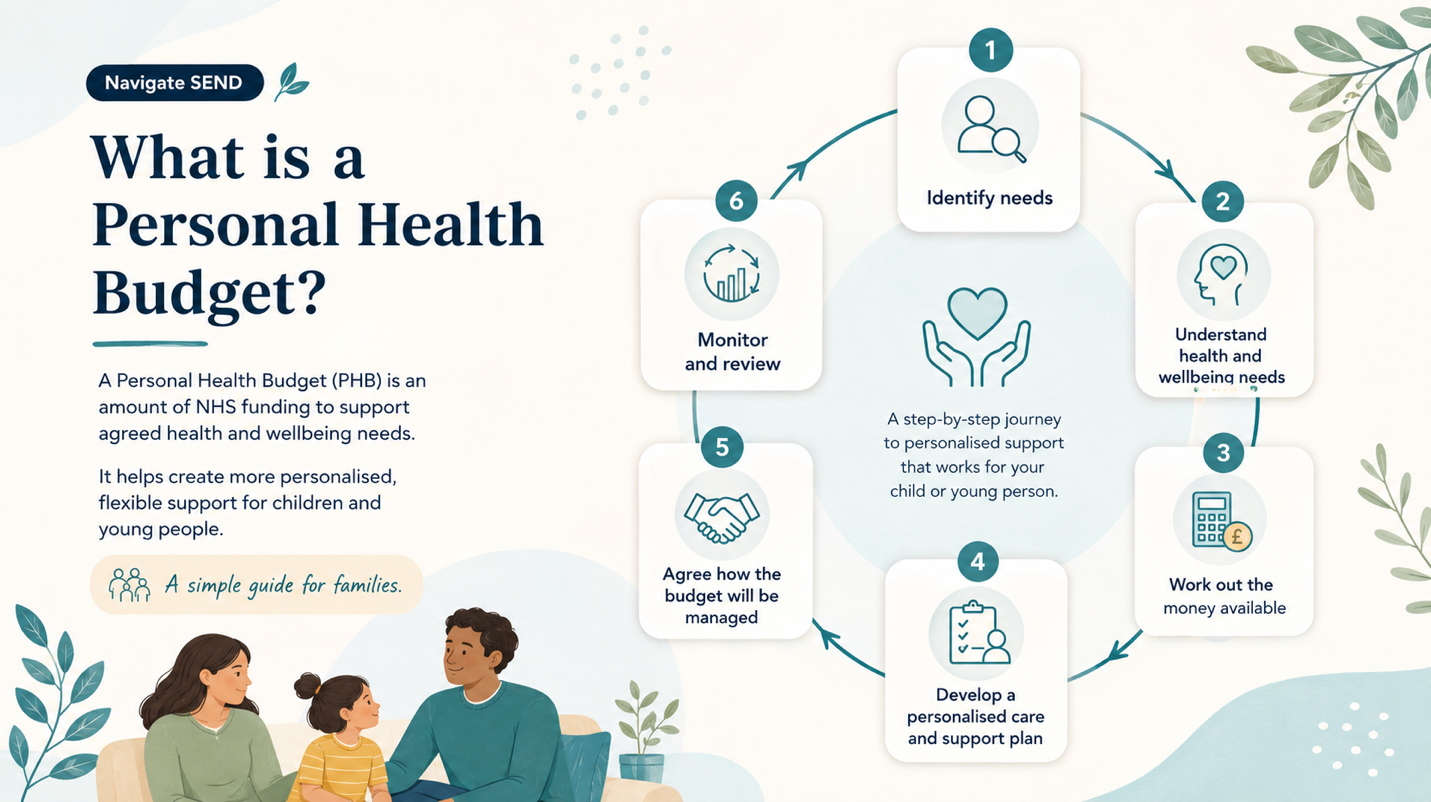
For health, NHS England explains that a personal health budget uses NHS funding to create an individually agreed personalised care and support plan. A personal health budget may be managed as a notional budget held by the NHS, a third-party budget, a direct payment, or a combination.
In practical terms, families may see three main models:
1. Notional budget
The council, NHS or other organisation holds the money and arranges the support.
2. Direct payment
The money is paid to the family, young person, adult, representative or nominee to arrange agreed support.
3. Third-party or managed arrangement
Another organisation manages the money and arranges support on behalf of the person or family.
A mixed package is also possible. For example, the local authority may commission some support directly while the family receives direct payments for another part.
What can social care direct payments be used for?
Social care direct payments should be used to meet assessed social care needs and agreed outcomes.
For disabled children, this may include support under children’s social care law. Families may request a child in need assessment, a disabled child assessment, a parent carer’s needs assessment, short breaks assessment or occupational therapy assessment depending on the issue.
Support that may be considered includes:
- short breaks or respite;
- personal assistants;
- support to access clubs, activities or the community;
- support during school holidays;
- personal care;
- help with sleep routines or supervision;
- support for independence skills;
- home help;
- travel assistance linked to services;
- equipment or adaptations routes;
- support for family life;
- direct payments to arrange assessed support.
For adults, the Care Act 2014 framework becomes central. GOV.UK’s Care Act statutory guidance says everyone whose needs are met by the local authority must receive a personal budget as part of the care and support plan or support plan. (gov.uk) That budget should give clear information about the money allocated to meet needs identified in assessment and recorded in the plan.
The budget must be sufficient to meet assessed needs. That is an important point. A direct payment should not be set so low that the family or young person cannot actually buy the agreed support. If agreed provision in the plan is not being delivered at all, that is a separate issue in its own right.
What can a personal health budget be used for?
A personal health budget is different because it uses NHS funding and must meet assessed health and wellbeing needs.
NHS England says personal health budgets can be used for ongoing care and support, such as NHS Continuing Healthcare, children and young people’s continuing care, and section 117 aftercare under the Mental Health Act. They can also be used for one-off budgets to support specific health goals or outcomes, including hospital discharge or mental health recovery.
For children and young people with complex health needs, a personal health budget might help arrange a package that is more flexible than standard commissioned services. This might include support workers, health-related personal assistant support, delegated healthcare tasks where properly agreed, equipment, therapies, respite linked to health needs, or support that helps the child or young person stay safe, well and able to participate in daily life.
There are limits. NHS England guidance says direct payments for healthcare cannot be used to buy GP services, urgent or emergency treatment, surgical procedures, NHS charges, alcohol, tobacco, gambling or anything unlawful. (england.nhs.uk) The money must be spent on services agreed in the personalised care and support plan.
The key question is:
“Has the NHS assessed a health or wellbeing need, and could a personal health budget meet that need in a more personalised way?”
Who has a right to a personal health budget?
Some groups have a legal right to have a personal health budget. NHS England guidance identifies these as adults receiving NHS Continuing Healthcare, children and young people eligible for continuing care, people eligible for section 117 aftercare, and people eligible for an NHS wheelchair, through personal wheelchair budgets. (digital.nhs.uk)
This does not always mean a right to receive the money as a direct payment. It means the person has a right to a personal health budget. The way it is managed still needs to be considered, and the direct payment route must meet the relevant conditions.
For other people, a personal health budget may still be considered where it would help meet assessed needs, but the right may not be automatic.
Families should ask the responsible Integrated Care Board (ICB), NHS team or continuing care team:
- Is my child or young person eligible for a personal health budget?
- Could the health element of the EHCP be delivered through a personal health budget?
- Could a direct payment be considered?
- What support is available to manage it?
- What are the review and monitoring arrangements?
How do these budgets connect with EHCPs?
An EHCP can include education, health and social care provision. Personal budgets and direct payments can therefore overlap with EHCP planning, but the source of responsibility still matters.
In an EHCP:
- Section F is special educational provision.
- Section G is health care provision.
- Section H1 and H2 are social care provision.
- Section J records personal budget information, including direct payments where agreed.
The most important issue is whether the provision educates or trains the child or young person. If health or social care provision educates or trains, it should be treated as special educational provision. That may mean it belongs in Section F, not Section G or H.
This distinction matters because the local authority has a strong duty to secure special educational provision in Section F. (gov.uk) Health and social care provision may be arranged through different duties and different complaint or review routes. Where the wrong section is used, this is usually corrected through an EHCP amendment.
For example, community access support might be social care. But if a structured community programme is teaching travel training, independence, communication or vocational skills, it may be educational or training provision. The wording and section of the EHCP can make a real difference.
How can families ask for personal budgets or direct payments?
Families do not need to use complicated wording. A clear request is usually best.
For social care, families might say:
“We are requesting an assessment of our child’s social care needs and a parent carer’s needs assessment. We would like the assessment to consider whether support could be provided through direct payments, including short breaks, community access, personal care and support during school holidays.”
For health, families might say:
“We would like to discuss whether a personal health budget or direct payment could be considered for the assessed health needs in the continuing care plan / EHCP / personalised care and support plan.”
For an EHCP review, families might say:
“We would like the annual review to consider whether a personal budget or direct payment is appropriate for the provision described in the plan, and whether Sections G, H and J need to be updated.”
Families should ask for decisions in writing. If a request is refused, the decision should explain why and what alternative arrangements will be made.
Why direct payments can go wrong in practice
Direct payments can give families more flexibility, but they can also create practical stress. (parliament.uk, nao.org.uk)
Common problems include:
- unclear information about what can be requested;
- delays in decisions or payments;
- budgets that do not cover the real cost of support;
- families being asked to manage complex employment responsibilities;
- disputes about whether spending is allowed;
- lack of payroll or brokerage support;
- difficulty finding personal assistants;
- prepaid card restrictions;
- confusion over whether the issue is health, social care or education;
- reviews that reduce support without a clear explanation.
The Local Government and Social Care Ombudsman’s personal budgets focus report found inconsistencies in how councils complied with personal budget duties, including administrative failings, delays, councils not recognising requests, poor decision processes and lack of information on council websites. (lgo.org.uk)
Direct payments should not simply transfer pressure to families. They should be supported, realistic and linked to clear outcomes.
How Navigate SEND supports families with health and social care budgets
Navigate SEND helps families and professionals understand whether a personal budget or direct payment is the right route, and how it fits into the wider SEND picture.
We can help by:
- identifying whether the issue is education, health or social care;
- reviewing what has been assessed and what is missing;
- helping families prepare a clear request;
- checking whether the support should sit in Section F, G, H or J of an EHCP;
- organising evidence about respite, community access, personal care and family strain;
- supporting annual review preparation;
- helping families respond to unclear or refused requests;
- clarifying whether a personal health budget, social care direct payment or EHCP personal budget is being discussed;
- helping families ask practical questions about sufficiency, monitoring and payroll support;
- identifying when a complaint, review or wider strategic route may be needed.
The aim is not to push every family towards direct payments. They are not right for everyone. The aim is to help families understand their options, make informed decisions and avoid being left with support arrangements that are unclear or unworkable.
Questions families often ask
Are personal budgets and direct payments the same thing?
No. A personal budget is the amount identified to meet assessed needs. A direct payment is one way of receiving and managing that budget yourself.
Can direct payments pay for respite or short breaks?
Yes, they can in some cases, if respite or short breaks have been assessed as needed and are included in the care plan, support plan or relevant social care arrangement.
Can a personal health budget be used for anything we think would help?
No. It must be used for health and wellbeing needs and outcomes agreed in the personalised care and support plan. Some services, such as GP services, emergency treatment and surgical procedures, cannot be bought using healthcare direct payments.
Can health and social care budgets be combined?
Sometimes. NHS England guidance and Care Act guidance both recognise that direct payments and personal budgets can be integrated or combined where the person and relevant organisations agree, while each body remains responsible for its own duties.
Can Navigate SEND help if a direct payment is refused or too low?
Yes. Navigate SEND can help review the decision, organise the evidence, clarify whether the budget is sufficient, and prepare a clear next step with the local authority, ICB or EHCP review process.
Next step
If you are unsure whether personal budgets or direct payments could help with health, social care or EHCP provision, Navigate SEND can help you understand the options, organise the evidence and prepare the strongest request.