What is the difference between EHE and EOTAS/EOTIS?

Matt Bell
EOTAS and EHE are often confused, but they are very different routes. Elective Home Education (EHE) is when parents choose to educate their child otherwise than at school. Education Otherwise Than At School or In School (EOTAS/EOTIS) is different: it is usually used where a child or young person with an Education, Health and Care Plan (EHCP) needs special educational provision arranged outside a school, college or other formal setting because provision in that setting would be inappropriate.
This distinction matters because more children and young people with complex, multiple or fluctuating needs are struggling to access traditional school placements. Families may be offered home education, alternative provision or online learning, but those routes do not all carry the same duties, funding or protection.
The short answer
EHE is a parental choice: parents take responsibility for providing suitable education, and the local authority may no longer have to secure the EHCP provision if it is satisfied suitable arrangements are being made. EOTAS/EOTIS is different: it is usually a local-authority-arranged EHCP package under Section 61 where school or college provision would be inappropriate. Section 19 is different again: it is the local authority safety-net duty where a child of compulsory school age would otherwise miss suitable education because of illness, exclusion or other reasons.
Why education outside school is growing
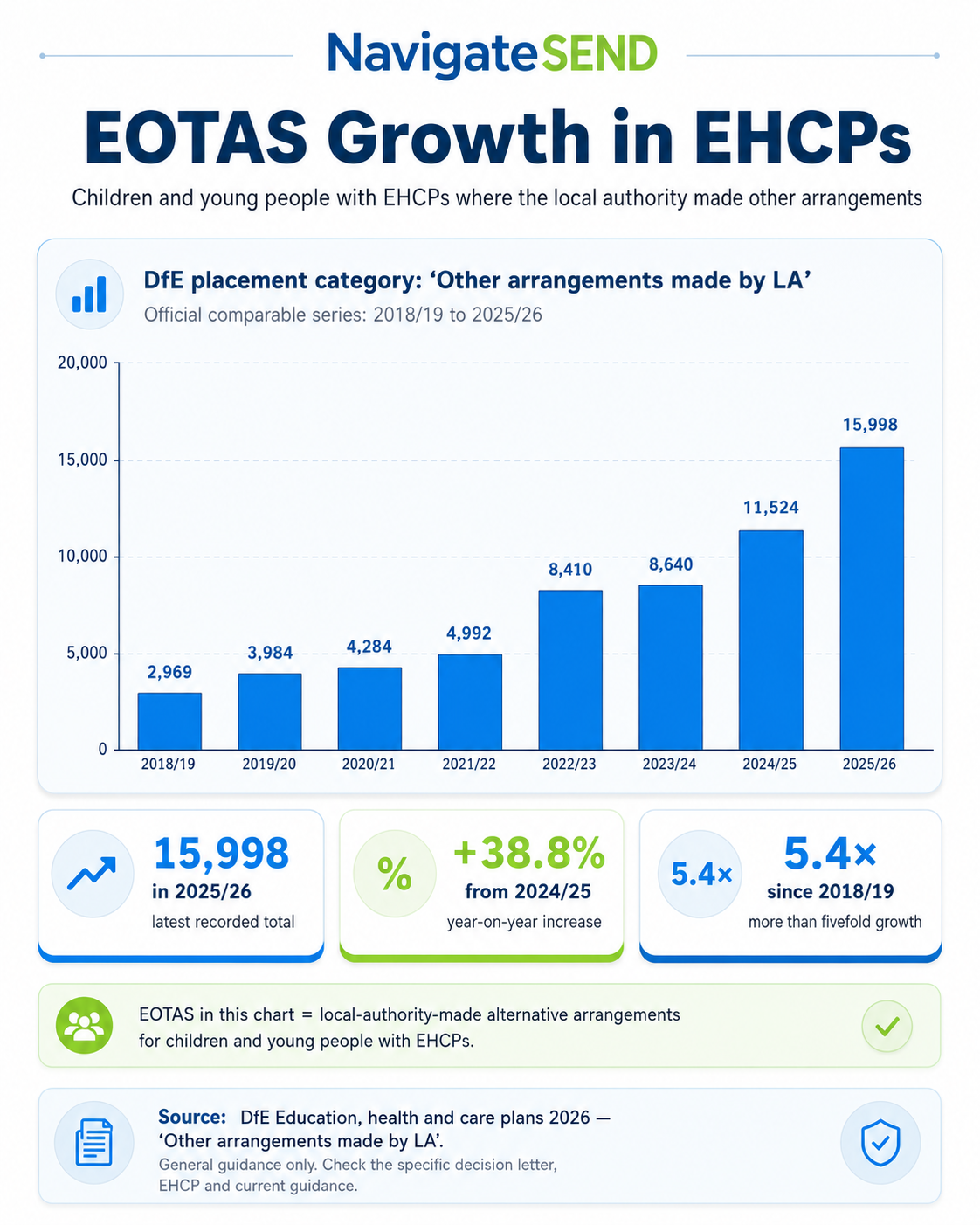
The demand for education outside school is now visible in national data. The 2026 EHC plan statistics recorded 62,400 children and young people with EHCPs attending placements other than school, early years or further education. That was a 25.3% increase from 2025 and represented 8.7% of all children and young people with EHCPs. Within that category, 16,000 were recorded as having alternative arrangements made by the local authority, described by DfE as educated other than at school (EOTAS), a 38.8% increase from 2025. A further 9,100 were electively home educated, 27.1% higher than in 2025, and 22,000 were not in education, employment or training. (explore-education-statistics.service.gov.uk)
The wider picture is also changing. In autumn 2025, 126,000 children were recorded as electively home educated on census day, and 175,900 were in EHE at some point during the 2024/25 academic year. (explore-education-statistics.service.gov.uk) The children missing education release recorded 34,700 children missing education on census day in autumn 2025 and an estimated 143,500 at some point during 2024/25. (explore-education-statistics.service.gov.uk)
Alternative provision is growing too. DfE’s 2024/25 school data recorded 27,900 pupils in school-arranged alternative provision at January 2025; 30.1% had an EHCP and a further 41.0% were receiving SEN Support. Local-authority-arranged placements in non-state-funded alternative provision increased by 24% to 59,700 placements in 2024/25, and 78.2% of those placements were because the setting was named on an EHCP. (explore-education-statistics.service.gov.uk)
These numbers do not all mean the same thing, and they should not be merged together. EHE, EOTAS, section 19 education, AP and children missing education are separate categories. But taken together, they show the same pressure point: for a growing number of children and young people, ordinary school or college attendance is not working.
EHE is not the same as EOTAS/EOTIS
Elective Home Education is based on the parent’s duty under Section 7 of the Education Act 1996 to secure efficient full-time education suitable to the child’s age, ability, aptitude and special educational needs, either by regular attendance at school or otherwise. (legislation.gov.uk) Parents do not need to be qualified teachers, do not have to follow the National Curriculum, and do not have to reproduce a school timetable.
But EHE is a serious decision, especially where a child has an EHCP. If parents choose EHE and the local authority is satisfied that suitable arrangements are being made, the local authority may be relieved of the duty to secure the special educational provision in the plan. That means therapies, specialist teaching, support workers or structured programmes may become the parent’s responsibility unless the EHCP is written differently.
That is why EHE is rarely the safest route where the real issue is that a child needs a funded, multidisciplinary package. Some families choose EHE positively and successfully. But where a family feels pushed into it because a school cannot cope, a special school place is unavailable, or the child is medically or emotionally unable to attend, the question should be whether this is genuinely elective home education or whether the local authority should be considering section 19 education or EOTAS/EOTIS.
What is EOTAS/EOTIS?
EOTAS/EOTIS usually refers to special educational provision arranged otherwise than in a school, post-16 institution or early years setting. The key statutory route for children and young people with EHCPs is Section 61 of the Children and Families Act 2014. This allows a local authority to arrange necessary special educational provision outside a school or institution only if it is satisfied that it would be inappropriate for that provision to be made in such a setting. (legislation.gov.uk)
The word “inappropriate” is important. It does not simply mean a parent prefers home-based provision, or that the local authority has not found a place yet. It requires an individual decision about whether provision in a school or college would be inappropriate in the circumstances of that child or young person.
A proper EOTAS/EOTIS package might include specialist teaching, therapy, tutoring, mentoring, rehabilitation, assistive technology, vocational learning, community-based learning, travel training, personal care support, psychological input, education psychology oversight, occupational therapy, speech and language therapy, physiotherapy, clinical neuropsychology, or case management. The exact package should follow the child or young person’s needs and outcomes.
For EOTAS/EOTIS to work, Section F of the EHCP needs to be specific. It should say what will be delivered, how often, by whom, where, and for what purpose. A vague phrase such as “access to online learning” is unlikely to be enough for a child with complex physical injury, acquired brain injury, traumatic brain injury, fatigue, sensory regulation needs, pain, executive functioning difficulties or emotional adjustment after injury.
Where Section 19 fits in
Section 19 of the Education Act 1996 is another important route. It applies to children of compulsory school age who, because of illness, exclusion or otherwise, would not receive suitable education unless the local authority makes arrangements. (legislation.gov.uk)
This can apply where a child is temporarily or persistently unable to attend school because of physical health needs, mental health needs, placement breakdown, exclusion, anxiety, trauma or other barriers. It is not the same as EHE and it is not the same as a full EOTAS/EOTIS EHCP package. It is a safety-net duty to ensure the child receives suitable education now. (lgo.org.uk)
In practice, families often need section 19 education while longer-term EHCP questions are being resolved. For example, a child may need interim home tuition, online learning or therapeutic education while the local authority considers whether the EHCP should be amended to include EOTAS/EOTIS, a different placement or a phased return plan.
Why brain injury and complex injury cases expose the gap
Acquired brain injury, traumatic brain injury and complex physical injuries can expose the limits of standard education pathways. A young person may appear academically able, but have fatigue, processing delay, memory difficulty, executive functioning problems, emotional changes, sensory overload, pain, reduced stamina, mobility issues, communication changes or fluctuating capacity. They may be “twice exceptional”: intellectually capable but functionally unable to access a normal school day.
Headway reported 335,409 UK hospital admissions for acquired brain injury in 2023/24, including 123,969 head injury admissions. (headway.org.uk) Not all of these are children, and not every injury results in long-term educational needs. But the scale matters, especially when schools and local authorities do not routinely treat brain injury as a distinct educational pathway.
NICE guideline NG252, published in October 2025, covers rehabilitation in all settings for children, young people and adults with chronic neurological disorders, neurological impairment or disabling neurological symptoms due to acquired brain injury, acquired spinal cord injury, acquired peripheral nerve disorder, functional neurological disorder or progressive neurological disease. (nice.org.uk) This is important because it recognises rehabilitation as an ongoing, cross-setting process, not simply a short medical episode.
The Rehabilitation Code 2015 also matters in injury cases. Its purpose is to help the injured claimant make the best and quickest possible medical, social, vocational and psychological recovery. (iua.co.uk) In complex education cases, that approach often points towards coordinated rehabilitation, not fragmented tutoring.
This is where education policy often feels behind practice. Many local policies describe autism, SEMH, cognition and learning, physical disability or sensory impairment, but acquired brain injury and complex injury do not always sit neatly in those boxes. The child’s symptoms may be discussed, but the underlying brain injury may be missing from Section B of the EHCP, and the rehabilitation package needed in Section F may not be understood.
What SAiL/Sails-OP was built to address
Before Navigate SEND, Matthew Bell created SAiL/Sails-OP, now taken forward as Leftfield Learning Collective, as a specialist model for young people whose needs did not fit ordinary school pathways. The original EOTAS work focused especially on young people with acquired and traumatic brain injury and complex physical injury, where education needed to sit alongside rehabilitation, independence, vocational planning and emotional adjustment.
That experience is important because it shows why EOTAS/EOTIS cannot just be a list of tutors. For many young people, the package needs a coherent plan: assessment, rehabilitation goals, cognitive pacing, academic access, community access, therapy, assistive technology, rest and recovery, vocational planning, transition work, and careful monitoring of progress.
In these cases, an independent case manager can be crucial. NICE NG252 and the Rehabilitation Code both support the logic of coordinated rehabilitation. A case manager can help connect education, health, therapy, family life, transport, personal care and long-term outcomes. Without that coordination, families can be left managing a package that is technically funded but not strategically joined up.
Where EOTAS/EOTIS goes wrong
EOTAS/EOTIS can go wrong in several common ways.
- Families are encouraged towards EHE when the real issue is school failure or placement breakdown.
- The EHCP says “EOTAS” but Section F does not quantify the package.
- The local authority funds tutoring but not rehabilitation, therapy or case management.
- Provision is commissioned piecemeal and nobody tracks outcomes.
- Health and education professionals do not share information.
- The package depends on parents coordinating everything.
- The plan does not explain what happens if a tutor, therapist or support worker is unavailable.
- The child is recorded as receiving education, but the education is too narrow, too short or not matched to need.
Recent Ombudsman decisions show how easily confusion can arise. In one 2026 case, a council was found at fault for giving confusing information about EOTAS and raising a family’s expectations that EOTAS would be provided, before saying the child did not meet the criteria. (lgo.org.uk) In another 2025 decision, an EHC plan was amended to remove a school placement and replace it with EOTAS, but the plan still did not quantify the overall education hours and much of the wording still read as if the child was in school.
The lesson is clear: EOTAS/EOTIS needs proper drafting, proper commissioning and proper review. It should not be a vague label.
How families should approach EHE, section 19 and EOTAS/EOTIS
Families should start by identifying which route they are actually being offered.
If the family is choosing to take full responsibility for education, that is EHE. If the child is unable to attend school and needs interim education while placement or health issues are resolved, section 19 may be relevant. If the EHCP needs to specify a long-term or medium-term package outside a school or college because school-based provision would be inappropriate, EOTAS/EOTIS may be the route.
Families should ask for clarity in writing:
- Are you treating this as EHE, section 19, alternative provision or EOTAS/EOTIS?
- Who is legally responsible for arranging and funding the provision?
- Will the child remain on roll anywhere?
- What exactly will be delivered each week?
- Who will coordinate the package?
- How will therapies and rehabilitation be integrated?
- How will progress and outcomes be reviewed?
- How will this be written into Section F of the EHCP?
- What is the plan if school or college becomes appropriate again later?
Where brain injury or complex physical injury is involved, families should also ask whether the local authority has considered rehabilitation evidence, NICE NG252, clinical advice, occupational therapy, physiotherapy, neuropsychology, speech and language therapy, fatigue management and vocational rehabilitation.
How Navigate SEND supports EHE and EOTAS/EOTIS cases
Navigate SEND helps families, young people, case managers and professionals work out which route is actually being discussed and what evidence is needed.
We can help by reviewing the EHCP, identifying whether the issue is EHE, section 19, EOTAS/EOTIS, alternative provision or placement breakdown, mapping needs against provision, preparing annual review or amendment requests, supporting evidence around brain injury and complex injury, helping families ask for independent professional input, checking whether Section F is specific enough, and preparing the case where Tribunal, complaint or strategic negotiation may be needed.
We can also help professionals design packages that are not just “education at home”, but coherent education, rehabilitation and preparation-for-adulthood pathways. In complex cases, the right package often needs tutoring, therapy, pacing, independence work, family support, case management and clear reporting into the EHCP review cycle.
The aim is not to move children out of school unnecessarily. The aim is to protect access to meaningful education where school-based provision is not currently appropriate or has already failed.
Questions families often ask
Is EHE the same as EOTAS/EOTIS?
No. EHE is a parental choice to educate a child at home. EOTAS/EOTIS is normally a local-authority-arranged EHCP package where special educational provision is made outside school because provision in a school or college would be inappropriate.
Can a child with an EHCP be electively home educated?
Yes, but families should be careful. If the local authority is satisfied parents are making suitable arrangements, it may no longer have to secure the special educational provision in the EHCP. This can make EHE risky where the child needs funded specialist provision.
What is Section 19 education?
Section 19 is the local authority duty to arrange suitable education for a child of compulsory school age who would otherwise miss education because of illness, exclusion or other reasons. It can be important while longer-term EHCP or placement issues are resolved.
Can EOTAS/EOTIS include therapy and rehabilitation?
Yes, where therapy, rehabilitation or training is special educational provision needed to meet the child or young person’s needs. It should be clearly specified in Section F of the EHCP.
Can Navigate SEND help design or challenge an EOTAS/EOTIS package?
Yes. Navigate SEND can help organise evidence, review EHCP wording, clarify the legal route, map the package, and support annual review, amendment, complaint or Tribunal preparation where needed.
Next step
If your child or young person is being pushed towards home education, is out of school, or may need EOTAS/EOTIS because school or college is not appropriate, Navigate SEND can help you understand the route, organise the evidence and prepare the strongest next step.